

A Good Girl's Guide to Murder S2E4 Ending Explodes the Catfish Theory
- Rajveer Singh

- 3 hours ago
- 4 min read
The catfish was never a teenager. The fourth episode of A Good Girl's Guide to Murder Season 2 ends with Pip Fitz-Amobi isolating the background audio from Jamie’s burner phone, revealing that the "Layla Mead" profile was a digital smokescreen operated by an adult resident of Little Kilton. The realization fundamentally shifts the genre of the show. By moving the guilt from the high school locker room to the adult establishment, the series stops being a teen mystery and becomes a full-blown suburban tragedy.

A Good Girl's Guide to Murder Season 2
Episode 4 Ending Explained
The episode concludes with Pip using audio-enhancement software to clean up the chaotic voice note recovered from the Shilton farmhouse. By isolating the secondary voice in the recording, she confirms that the person who lured and attacked Jamie Reynolds is a much older, established adult in the Little Kilton community. Pip realizes that the "Layla Mead" identity wasn't a teenage prank gone wrong, but a calculated trap designed to silence Jamie before he could expose a decades-old historical crime.
The architecture of a mystery series requires a massive pivot at the end of its second act. If you look at [our breakdown of the A Good Girl's Guide to Murder S2E3 ending], the show was effectively pointing a massive, neon finger at Jamie’s immediate peer group. We were led to suspect Nat Da Silva, Luke, or a disgruntled ex-colleague. Showrunner Poppy Cogan spent three episodes weaponizing our own biases about Gen-Z digital cruelty. We assumed a catfish had to be a teenager because catfishing is a young person's game.
The brilliance of the Episode 4 ending is how it weaponizes that assumption. When Pip finally scrubs the audio from the burner phone, the voice that emerges isn't a panicked high schooler. It is the measured, terrifyingly calm cadence of an adult.
This structural move is exactly what elevates the series above standard YA fare. Network television loves to blame teenagers for their own destruction. It is much easier to write a script about cyberbullying than it is to examine the systemic rot of the adults who built the town. But by revealing that "Layla" is an adult, the show aligns itself more closely with the bleak, generational guilt of a show like Broadchurch. The digital traps—the fake Instagram profiles, the Snapchat maps, the burner phones—were just modern tools being used by the old guard to protect an analog secret.
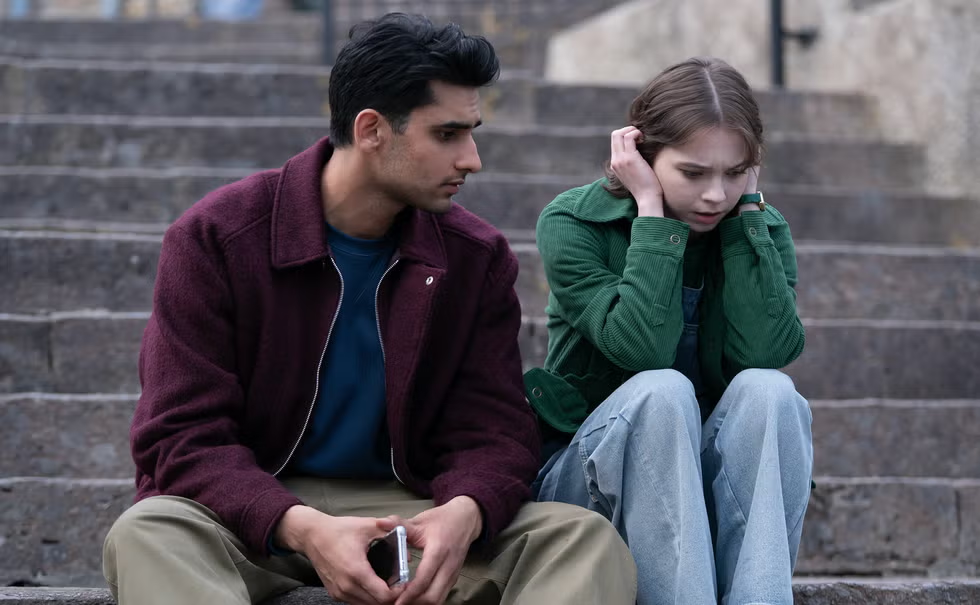
We also have to look at the visual grammar of the audio-scrubbing scene. This is a trope as old as Brian De Palma’s Blow Out. Usually, when the cinematic detective enhances the audio and hears the killer, it is framed as a triumphant "gotcha" moment of intellectual victory. Director Poppy Cogan refuses to grant us that catharsis. The camera stays tight on Emma Myers’ face, and what registers isn't triumph, but profound isolation. As I noted in our [analysis of Netflix's current true-crime adaptation strategies], the best of these shows remember the psychological toll of the investigation. When Pip hears that adult voice, she realizes she is completely out of her depth. The safety net of her youth is gone. She isn't outsmarting her classmates anymore; she is actively hunting a predator who has successfully hidden in plain sight for decades.
This revelation also recontextualizes Jamie’s disappearance entirely. Jamie wasn't a tragic, naive victim of a romance scam. He was an active investigator. The breadcrumbs he was following prior to the Andie Bell memorial weren't leading him to a secret lover—they were leading him to a historical crime that the adults of Little Kilton had successfully buried. He was silenced because he was getting too close to the architectural foundation of the town's lies. The tragedy is that Pip had to retrace his exact steps to figure it out, placing herself squarely in the crosshairs of the exact same adult.
What Comes Next
With the suspect pool entirely inverted, Episode 5 will have to be a paranoid deep-dive into the history of Little Kilton's establishment. Pip knows the "Layla" profile is tied to a historical cover-up, meaning she will likely have to cross-reference the town's older public records, news archives, and police reports from before she was even born. The immediate danger is that this adult knows Jamie left a digital trail. Whoever they are, they are embedded deeply enough in the community to watch Pip's every move. Expect the next episode to feature a terrifying game of cat-and-mouse as Pip tries to unmask the adult without letting them know she has the audio recording.
Quick Facts
Release Date: May 27, 2026
Platform: Streaming globally on Netflix. Available on BBC iPlayer in the UK. (Available internationally via standard Netflix apps).
Director / Showrunner: Poppy Cogan
Runtime: 47 minutes
Cast: Emma Myers, Zain Iqbal, Asha Banks, Jude Morgan-Collie, Eden H. Davies
Status: Streaming Now [Just Dropped]
Frequently Asked Questions
Who is the voice on Jamie's burner phone in Episode 4?
While the specific identity is withheld for the finale, Pip's audio enhancement confirms the voice belongs to an older, male adult resident of Little Kilton. This shatters the theory that Jamie was attacked by one of his teenage peers.
Was Layla Mead a real person?
No. The episode confirms that the Layla Mead persona was entirely fabricated by an adult using stolen photographs. It was a digital honey-trap designed specifically to exploit Jamie's isolation and lure him to the Shilton farmhouse.
What is the historical crime connected to Jamie's disappearance?
The show heavily implies that the adult attacker is covering up their involvement in a decades-old crime that predates the Andie Bell case. Jamie had inadvertently stumbled upon their true identity, making him a lethal liability.
Does Pip take the audio recording to the Little Kilton police?
She refuses to hand over the burner phone. Given the police force's prior incompetence and her realization that the killer is an established adult in the community, Pip believes the institution itself might be compromised.

Comments