
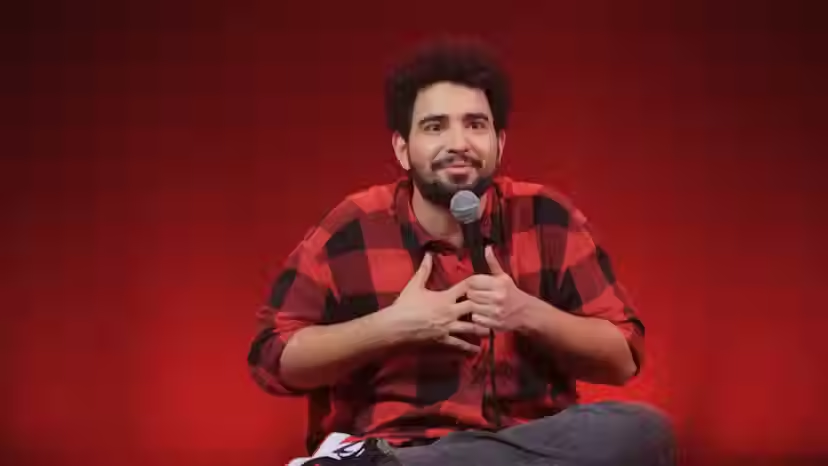


Tera Sai Cast: Sanjay Mishra Becomes Sai Baba, And The Shirdi History Behind The Film
Sanjay Mishra has spent thirty years being the most believable man in any room he walks into. Now he is playing Sai Baba of Shirdi — and the shoot is already done.

Tera Sai, written and directed by Palash Muchhal and presented by Red Eye Studio, wrapped filming on 3 August 2026. Muchhal called the wrap an emotional and fulfilling moment, and the film has now moved into post-production. It is expected to release in 2027, across Hindi, Marathi, Telugu and Tamil.
Alongside Mishra, the film features Sayaji Shinde, Manoj Joshi, Omkar Das Manikpuri, Avika Gor and Rohan Mehra in significant roles. That is a cast built for texture rather than for star wattage, which tells you something about what Muchhal is going for.
Who stars in Tera Sai, and what is the film about?
Sanjay Mishra plays Sai Baba of Shirdi in Tera Sai, a spiritual drama written and directed by Palash Muchhal (also credited in some coverage as Palaash Muchhal). The supporting cast includes Sayaji Shinde, Manoj Joshi, Omkar Das Manikpuri, Avika Gor and Rohan Mehra. The film draws on the life and teachings of Sai Baba — faith, surrender, and the saint's insistence that caste and religion held no authority inside his mosque. Shooting wrapped on 3 August 2026; release is expected in 2027 in four languages.
Tera Sai: the confirmed details
Title: Tera Sai
Lead: Sanjay Mishra as Sai Baba of Shirdi
Writer-director: Palash Muchhal
Presented by: Red Eye Studio
Ensemble: Sayaji Shinde, Manoj Joshi, Omkar Das Manikpuri, Avika Gor, Rohan Mehra
Status: Shoot wrapped 3 August 2026; in post-production
Expected release: 2027, in Hindi, Marathi, Telugu and Tamil
Announced: April 2026, at the Shree Saibaba Sansthan temple in Shirdi
Why Sanjay Mishra is an unusual — and interesting — choice
Devotional cinema in India has a default setting: the saint is lit from behind, speaks in a register nobody actually uses, and floats about six inches above the story. It is reverence as distance.
Sanjay Mishra cannot do distance. His entire register is the opposite — the tired clerk, the broke father, the man cracking a joke because the alternative is crying. Casting that face as Sai Baba is a bet that the audience will connect to a saint who feels like someone who lived in a village and ate what the village gave him, because that is closer to what the historical record actually describes.
Muchhal announced the film in April 2026 not at a hotel press conference but at the Shirdi shrine itself, posting that Tera Sai began with blessings and describing it as a story of faith and surrender. The framing has been consistent since.
The ensemble — and what has not been announced yet
Here is the honest position: the actors are confirmed, the characters are not. Sayaji Shinde, Manoj Joshi, Omkar Das Manikpuri, Avika Gor and Rohan Mehra have all been named as playing significant roles, but no official casting note has attached them to specific figures from Shirdi's history.
Any list you see online matching these actors to named characters is a guess. We are not making one.
What we can say is which figures a Shirdi story almost certainly has to contain. Chand Patil, the village headman whose lost mare brought the young fakir back to Shirdi. Bhagat Mhalsapati, priest of the Khandoba temple, who greeted him with the two words that named him — Aao, Sai. Tatya Kote Patil, the devotee who lived alongside him. Laxmibai Shinde, who cooked for him. Whoever plays them, those are the relationships the film has to carry.
Who was the real Sai Baba of Shirdi?
He arrived in Shirdi in the mid-19th century as an anonymous young ascetic and never explained himself. No birth name. No caste. No hometown. When devotees pushed, he redirected — lineage is temporary, the soul is not.
He took up residence in a crumbling, abandoned mosque and named it Dwarkamai, welding Krishna's Dwarka onto a Sufi dwelling in a single word. Inside it he lit a fire, the Dhuni, and fed it daily. That fire is still burning in Shirdi today.
His life is recorded principally in the Shri Sai Satcharitra, compiled by Govind Raghunath Dabholkar, known as Hemadpant. It is devotional literature rather than a historian's account, and the miracle stories below are what that tradition records — held as true by millions of devotees, and read here in that spirit.
Four leelas the Satcharitra records
1. Lamps that burned on water
Sai Baba kept earthen lamps lit through the night in Dwarkamai, relying on small donations of oil from the village grocers. One Diwali the grocers decided to test him and refused. He returned with empty tins, filled them with well water, drank a mouthful, poured the rest into the lamps — and lit them. The Satcharitra records that they burned all night, and that the grocers ended up at his feet.
2. The storm that stopped
A violent storm once threatened to tear the thatch off Shirdi's poorest houses, and families ran to Dwarkamai. Sai Baba went to the entrance, raised his satka, and told the storm to calm down. The record says it did, within minutes.
3. Udi, the ash
Ash from the Dhuni, called Udi, became his standard prescription. Devotees with fevers, paralysis and cholera were given a pinch in water. Snakebite victims had it applied to the wound. Beyond the healing accounts, the Udi carried a blunt message: every body ends as ash, so stop mistaking it for the point.
4. The arm in the fire
One afternoon Sai Baba pushed his bare arm into the Dhuni. Tatya Patil pulled him back and asked why. He said that miles away a blacksmith's wife had stumbled and dropped her baby into a furnace, and that he had reached across to catch the child. The account holds that the child was found unharmed — and that Sai Baba carried the burns.
Sabka Malik Ek: the part that was genuinely radical
The miracles are what get retold. The social arrangement inside Dwarkamai is what should be.
This was 19th-century rural Maharashtra, where who you ate beside was a matter of law-like custom. Inside that mosque, Brahmins, landless labourers, Dalits, merchants and visitors sat on the same bare floor. Food came from one pot and was distributed without a separate line for anyone. He embraced people the village had labelled untouchable, washed their feet, and ate what they offered him.
Two principles held it together. Sabka Malik Ek — call it Rama, Allah or Shiva, it is one owner. And Shraddha and Saburi — faith and patience, in that order.
The Sabarimala parallel
Shirdi was not an isolated experiment. The same structural logic runs through the Ayyappan pilgrimage at Sabarimala in Kerala, and the resemblance is worth sitting with.
Every pilgrim wears the same black or dark blue. Wealth, profession and caste become invisible at a glance. Through the 41-day vratam, executives and daily-wage workers sleep on the same floor and cook together. Names and titles are dropped — everyone is Swami. And the route includes a mandatory stop at the shrine of Vavar Swamy, a Muslim companion of Ayyappan, which rhymes almost exactly with a Hindu-revered saint living in a mosque he named after Krishna.
Two traditions, two states, the same instinct: strip the markers, and what is left is the person.
Why Tera Sai lands at a useful moment
Devotional cinema is not a dead format in India — Shirdi Ke Sai Baba (1977) was a genuine box office event because it hit a nerve that runs through a lot of Indian households. What has changed is the audience's tolerance for reverence without a person underneath it.
A Sanjay Mishra performance is, structurally, the opposite of that. If Muchhal lets the film be small — a village, a fire, a man who will not explain where he came from — it has something. That is the bet. We will know in 2027.
FAQ
Who plays Sai Baba in Tera Sai?
Sanjay Mishra plays Sai Baba of Shirdi in Tera Sai, written and directed by Palash Muchhal and presented by Red Eye Studio.
Who else is in the Tera Sai cast?
Sayaji Shinde, Manoj Joshi, Omkar Das Manikpuri, Avika Gor and Rohan Mehra have been announced in significant roles. Their specific characters have not been officially confirmed.
When is Tera Sai releasing?
The shoot wrapped on 3 August 2026 and the film is in post-production. It is expected to release in 2027 in Hindi, Marathi, Telugu and Tamil. No exact date has been announced.
What are the most famous Sai Baba miracles?
The Shri Sai Satcharitra records lamps lit with water instead of oil, a storm calmed with his satka, healing through the sacred ash called Udi, and a child saved from a furnace miles away.
How did Sai Baba reject caste discrimination?
Inside Dwarkamai he seated all castes together on the same floor, served food from a single pot without separate lines, embraced people labelled untouchable, and taught Sabka Malik Ek — one owner for all.
How does Shirdi compare to the Sabarimala pilgrimage?
Both erase social markers. Sabarimala pilgrims wear identical dark clothing, drop their names to address each other as Swami, and visit the shrine of the Muslim companion Vavar Swamy — a structural echo of Sai Baba's caste-free, interfaith Dwarkamai.
Comments