

The Architecture of Awe: Decoding the Global Divide Between Television and the Silver Screen
- Kenneth Hopkins
- 4 days ago
- 3 min read

There is a persistent, structural delusion floating around contemporary media circles that the rise of high-budget streaming platforms has democratized acting. The modern commentator loves to claim that because a television series can now match the budget of a feature film, the historical barrier between the small screen and the silver screen has permanently dissolved. This is a profound misunderstanding of the medium. The chasm between a television actor and a legitimate movie star remains just as vast, rigid, and uncompromising in Hollywood as it is in Bollywood.
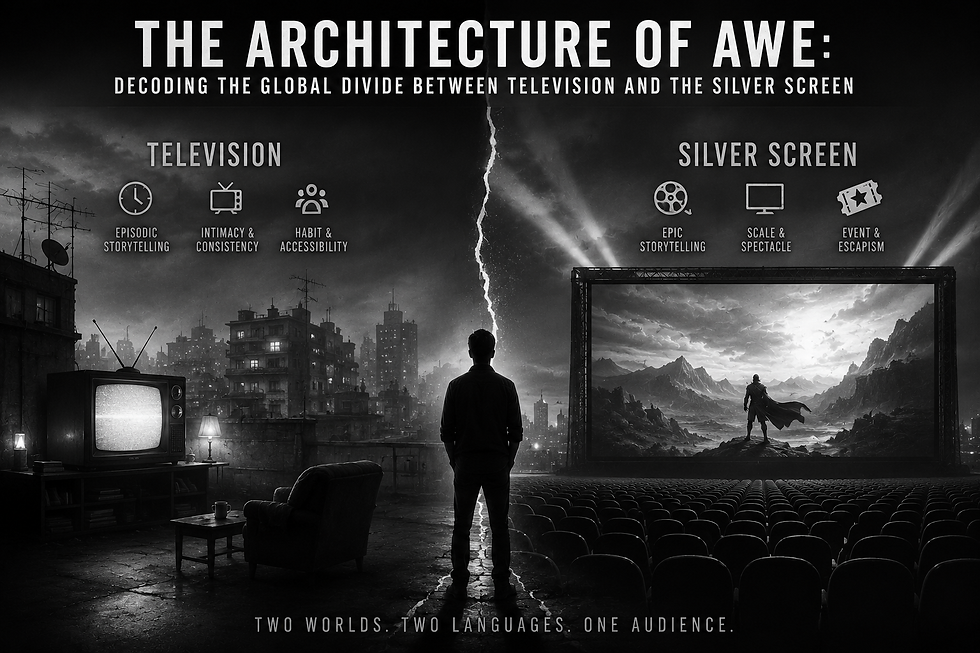
From Los Angeles to Mumbai, the entertainment industry operates on a strict, unwritten caste system. For every George Clooney or Shah Rukh Khan who successfully escaped the orbit of episodic television, there are thousands of incredibly talented television actors who find themselves permanently locked outside the gates of cinematic prestige. This divide is not an accident of timing, nor is it a reflection of an actor’s inherent talent. Rather, it is an inevitable result of how the two mediums interact with human psychology, audience economics, and the foundational concept of stardom.
The Premium of Proximity vs. The Currency of Mystique
At the heart of this divide lies the paradox of overexposure. Television, by its very architecture, is a medium of domestic intimacy. Whether an actor appears on a legacy broadcast network or a modern streaming application, they are entering the consumer’s home on a daily or weekly basis. They are watched in pajamas; they are paused during dinner; they are background noise while doing chores.
[Television: Intimacy & Overexposure] ---> Audience feels ownership ---> Familiarity kills mystique
[Cinema: Distance & Grandeur] ---> Audience pays a premium ---> Rarity breeds iconic stardom
This domestic proximity destroys the fundamental prerequisite of cinematic stardom: *mystique*. When an audience feels a sense of routine familiarity with an actor, they sub-consciously strip away that performer's larger-than-life aura.
The Television Effect: The viewer develops a psychological ownership of the performer, viewing them as a constant, reliable companion.
The Cinematic Effect: Cinema requires an economy of rarity. The true movie star demands that the audience explicitly purchase a ticket, leave their homes, and sit in a dark, communal hall to catch a glimpse of them. The moment a performer is available for the price of a monthly subscription or a basic cable package, their premium value as a box office draw is compromised.
The Character Trapped in the Living Room
Furthermore, the mechanics of television writing work actively against the fluid nature of cinematic reinvention. In a successful television series, an actor inhabits a single character for dozens, sometimes hundreds, of hours over several years. Jennifer Aniston struggled for a decade to shed Rachel Green; Jennifer Morrison remained trapped in the fairy-tale archetype of Once Upon a Time; and similarly, in India, phenomenal actors like Hina Khan or Mohit Raina spent years battling the massive cultural gravity of the singular characters that made them famous.
When an audience spends 80 hours watching you play a specific detective, a local doctor, or a mythological deity, they refuse to pay a premium to see you play an entirely different character on a 50-foot cinematic screen. The character swallows the actor whole. In contrast, a movie star’s primary currency is their ability to project their own core persona across varied, self-contained 120-minute narratives.
The Industrial Gatekeepers
This psychological barrier is reinforced by the institutional biases of studio casting directors on both sides of the globe. In Bollywood, legacy casting networks routinely pass over brilliant television actors under the explicit bias that they are "too exposed" or "too vernacular" for a premium theatrical release.
Hollywood operates on an identical, albeit more corporatized, financial logic. When a studio executive greenlights a $150 million theatrical feature, they are not looking for a great actor; they are looking for a financial guarantor—a face that can anchor global marketing campaigns, command magazine covers, and generate theatrical urgency. Because television is viewed as a medium driven by the writer and the conceptual hook rather than the individual lead, TV stardom rarely translates into box-office leverage.
Ultimately, the television-to-cinema divide endures because the two mediums serve entirely different cultural functions. Television is built on the comfort of consistency, while cinema is powered by the spectacle of the extraordinary. Until the modern industry realizes that a high streaming view-count is not the same thing as a paid theatrical ticket, the border between the living room and the theater will remain as heavily guarded as it has been since the dawn of the moving image.



Comments