


The New Grammar of Power in Bombay
- Kenneth Hopkins
- Jan 14
- 3 min read

One of the most fascinating things unfolding in Bombay right now is the way culture and politics are bleeding into each other, almost seamlessly. The city has always thrived in this grey zone, but the current moment feels particularly charged, especially when you trace the intersections of legacy, cinema, ideology, and municipal power.
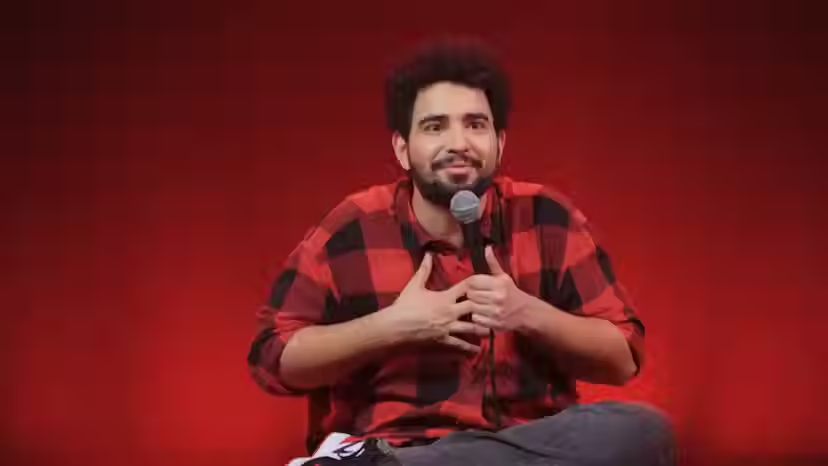
Take Akshay Waghmare, for instance. A respected Marathi actor with a strong body of work, his credibility as a performer is well established. His marriage to Yogita Gawli, affectionately known as Tai, places him within one of Mumbai’s most influential political families, the Gawlis.

The Gawli Legacy
Yogita Gawli is the daughter of Arun Gawli, widely known as Daddy. Few figures have shaped the socio-political fabric of Mumbai as profoundly as Arun Gawli. His philosophy, organisational discipline, and grassroots connect have left an indelible mark on the city.
His life was portrayed in the biopic Daddy, with Arjun Rampal delivering a performance that stood apart even within his accomplished career. The film offers a layered look at Bombay’s underbelly, its moral ambiguities, and the emergence of power structures outside traditional elite corridors.

The Rise of the Gawli Women
What is particularly striking today is how the next generation of Gawli women is carrying forward this legacy, each in her own political lane.
Geeta Gawli, Yogita’s sister, has been actively contesting elections under the banner of Akhil Bharatiya Sena, the party founded by Arun Gawli himself.

Vandana Gawli, wife of Pradeep Gawli, is contesting from Worli representing the Shiv Sena.

Despite contesting from different political formations, the ideological spine remains consistent. Discipline, territorial grounding, and a deeply Bombay-centric worldview run through all their campaigns.
This is a compelling counterpoint to the simplistic assumption that Indocentric politics is inherently patriarchal. These women are not symbolic inheritors of power. They are active carriers of political capital, organisational memory, and street-level legitimacy.
Bandra as the Cultural Battleground
Bandra, too, has emerged as a crucial theatre in this evolving equation. The BJP’s strategic candidate placement has made the constituency particularly competitive. Ward 101, often described as the cultural heartbeat of Bandra West, is seeing serious female leadership across party lines.
Prominent women leaders such as Swapna Mhatre and Alka Kerkar have brought administrative experience and organisational depth into the fray, setting the stage for a tightly fought contest.
While Shiv Sena (UBT) continues to rely on legacy narratives, the BJP’s focus on structured mobilisation and cultural stewardship suggests a deliberate attempt to reposition municipal governance as a cultural project, not merely an administrative one.
South Bombay and What Lies Ahead
In Worli, the Shinde faction appears well positioned, with Vandana Gawli emerging as a formidable contender. Further south, constituencies like Byculla and Mazgaon could see the Gawli sisters play a decisive role in shaping outcomes, reinforcing the family’s long-standing influence in central and South Bombay.
The Congress, by contrast, appears organisationally thin in these belts, struggling to match the on-ground momentum of its rivals.
Closing Thoughts
What we are witnessing is not just an election cycle. It is a recalibration of Bombay’s power grammar, where cinema, culture, lineage, and municipal politics converge. The Gawli women, across party lines, exemplify how legacy evolves rather than dissolves.
As Maharashtra and Mumbai move forward, these intersections will define how the city governs itself, narrates itself, and projects its identity.
Jai Maharashtra. Jai Swaraj.


Comments