

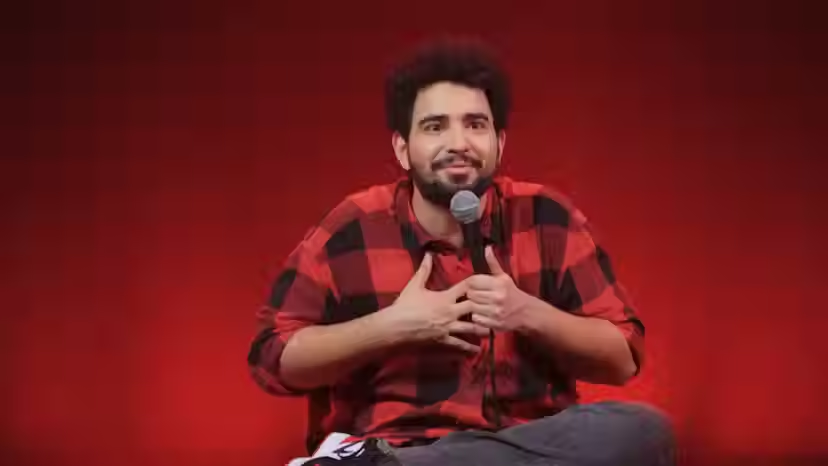
Why Stéphanie Boulay leaving music is a tactical shift
- Kenneth Hopkins
- 2 hours ago
- 3 min read

Stéphanie Boulay’s departure from the music industry to study law is not a retreat from creativity, but a calculated pivot toward institutional leverage. While the mainstream narrative frames her exit at 38 as a search for stability or a reaction to burnout, it is actually a diagnostic response to the total collapse of the streaming-era value proposition for mid-tier artists. Boulay is not leaving music because she no longer wants to make it. She is leaving because she has recognized that the current legal and economic architecture of the streaming business makes the profession unsustainable for anyone who does not hold the master rights.
The shift from creator to power-broker
Boulay, one half of the acclaimed Quebec folk-pop duo Les Sœurs Boulay, has not been shy about the "why." She is entering law school to specialize in entertainment and intellectual property law. This is the receipt that validates the thesis: Boulay is identifying that the true bottleneck for artists is not a lack of audience, but a lack of control over the infrastructure that monetizes their work. She is moving to where the power actually resides. By arming herself with the legal tools to challenge royalty distribution and contract opacity, she is doing more for the longevity of independent music than another album cycle ever could.

Why the dominant take is failing the artist
The prevailing discourse is treating this as a human interest piece—a singer finds a new hobby. This ignores the structural signal. Most reporting treats streaming royalty dissatisfaction as an annoying reality that artists simply have to live with. Boulay’s move proves that the frustration has reached a breaking point where the most effective path forward for an established artist is to exit the market as a participant and re-enter as an arbiter. She is rejecting the "starving artist" trope by pointing out that even after winning awards and building a fanbase, the math does not balance. The industry is losing a voice, but it is about to gain an advocate who knows exactly how the contracts are designed to fail the creator.
The Indian independent parallel
For the Indian independent music scene, Boulay’s decision is a mirror. We are currently in the middle of a massive expansion in the number of indie artists, yet we lack a concurrent legal movement to address the realities of platform-based compensation. Indian artists often mistake the "exposure economy"—high YouTube views, massive festival placements—for actual sustainability. Boulay’s exit is the quiet, sobering indicator that platform exposure is not a substitute for ownership. For the diaspora in Canada or the UK watching the music industry transform, Boulay represents a shift from romanticizing the grind to institutionalizing the defense of the creator.
The verdict
Stéphanie Boulay’s transition is the most significant artist-led move in the music industry this year. It signals that we have reached the end of the era where artists believe that simply making good work will solve their economic problems. If even successful artists are choosing the law over the stage, the streaming model is not merely flawed. It is fundamentally broken.
Detail | Information |
Artist | Stéphanie Boulay |
Duo | Les Sœurs Boulay |
Primary Reason | Unfair streaming economics / IP control |
New Direction | Entertainment and IP Law |
Source | Public statements / Quebec media |
FAQ
Why is Stéphanie Boulay leaving the music industry?
Boulay is leaving the music industry to pursue a law degree because she views the current economics of streaming as unsustainable for independent artists. She intends to use her legal education to advocate for better intellectual property protections and contract equity for musicians.
Did Les Sœurs Boulay break up?
Stéphanie Boulay’s return to school marks a pause in her career with Les Sœurs Boulay rather than a formal dissolution. The duo has a history of taking breaks for reinvention, but this specific move is driven by a desire to address structural industry failures.
What does Boulay’s career change signal about streaming?
It signals that the streaming model has reached a point where even established, award-winning artists cannot rely on it as a primary source of income. Her move is a public admission that the current business model fails to support the very people who produce the content it relies on.
How does this affect Indian indie artists?
It highlights a recurring global problem where independent artists gain platform exposure without gaining financial security. Boulay’s move serves as a warning that platform metrics are not an accurate proxy for a sustainable career.


Comments