


Why Ram Charan’s Peddi Fails to Reach Its Expected Level [Review and spoiler]

The highly anticipated theatrical release of Peddi has officially ignited the global box office, but the hyper-commercial sports action entertainer struggles under the weight of its own immense promotional machinery. While the high-octane second half and raw athletic choreography successfully rescue the narrative from absolute disaster, the film's glaring structural errors, inconsistent pacing, and highly regressive character framing ensure it falls significantly short of its expected level.
The action epic is currently playing in theatres globally, with post-theatrical digital streaming rights pre-allocated to Netflix for an international rollout later this year.
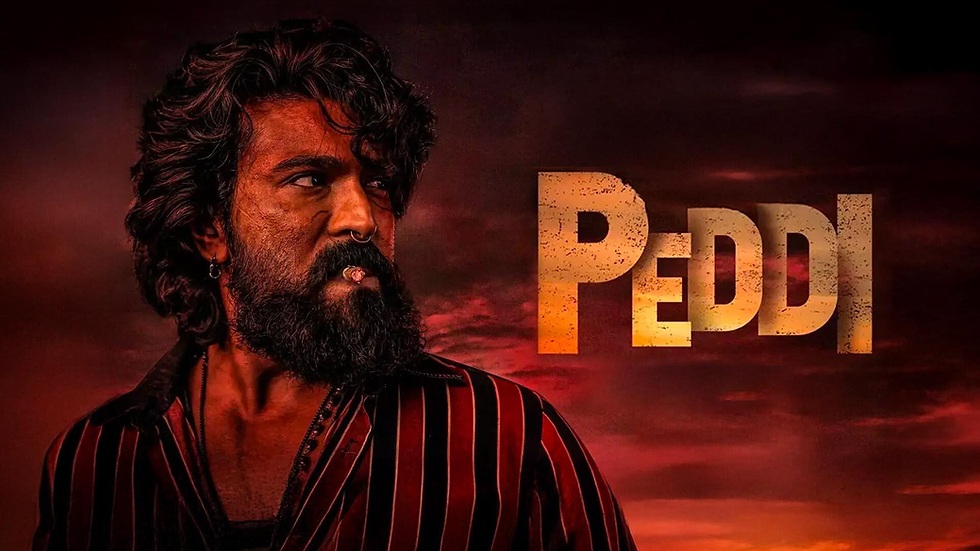
While the film ultimately finishes on a high note with a genuinely good second half and a highly satisfying, action-packed last portion, the writing leaves massive, inexcusable plot holes unresolved ahead of any potential sequel. Most notably, the script completely fails to show the ultimate ending or structural comeuppance of Bhadra—the brutal antagonist who famously broke Ram Charan's leg earlier in the film—leaving a vital narrative thread completely dangling before the rolling credits.
Streaming on Netflix in India. Available internationally via the Netflix global app.
Peddi Movie Review
Director Buchi Babu Sana’s Peddi delivers a grand but heavily flawed cinematic experience that ultimately earns a 3 out of 5 rating from AltBollywood. While its exhausting, over-commercialized first half fails to connect due to messy copycat choices and logic-defying action, the production beautifully redeems itself after the intermission, transforming into a deeply moving patriotic sports drama that tackles systemic displacement with genuine emotional weight.
Full Plot Breakdown
An unvarnished scene-by-scene analysis of the film reveals a production desperately fighting an internal identity crisis, split across two radically different halves.
The First Half Masala Overload and Absurd Physics
To be very honest, the first half of the movie simply isn't good. The screenplay collapses under an excessive dependency on cheap commercial tropes, cramming in far more unnecessary masala elements than audiences expected. The primary issue stems from a complete lack of narrative restraint; the cinematic buildup created by the director was simply too much to sustain.
In an effort to generate cheap theater whistles, the action physics completely abandon reality in a way that shatters basic viewer immersion—such as an early sequence where a human character hits a ball three entire grounds far away. The film only attempts to retroactively justify this absurd logic later through a bizarre, highly public dialogue incident where Ram Charan's character randomly insults global sports stars, explicitly calling elite cricketer Jasprit Bumrah a football player.
The Toxic Copycat Pushpa Effect
The largest creative failure plaguing the ensemble cast is a collective, desperate attempt to replicate the unique lightning-in-a-bottle success of other franchises. Multiple actors systematically overacted in almost every scene, explicitly trying to compete with the intense, gritty overacting that defined the Pushpa franchise.
While Pushpa remains a fundamentally good, highly stylized movie, it failed to fully satisfy a large segment of the demographic. By trying to outdo that specific aesthetic, Peddi ends up doing far more like Pushpa than Pushpa itself. This imitation extends directly to physical choreography, forcing Ram Charan to adopt a highly unnatural, exaggerated signature walk that feels entirely derivative rather than organic.
The Regressive Exploitation of Janhvi Kapoor and Audio Landscape
Perhaps the most egregious commercial misstep is the film's treatment of its female lead. The production uses Janhvi Kapoor strictly for her body, entirely wasting her dramatic potential to service a hyper-sexualized camera lens. The cinematography is relentlessly exploitative, ensuring her flank and hip are literally shown protruding out in almost every single scene she occupies, reducing her character to baseline visual decoration. To make matters worse, the highly anticipated Shruti Haasan cameo was slightly worse; she was completely used as a female asset just for her body, lazily mirroring the exact same exploitative approach previously seen in Pushpa.
This uneven creative execution filters straight down into the film's soundtrack. While the music was good, it was ultimately not that great. It feels as if music maestro A.R. Rahman knew exactly what kind of movie he was dealing with and simply made a generic song to fit the basic commercial requirements of the film rather than delivering an innovative, timeless score.
The Grounded Second Half: Outcast Identity and Social Justice
The movie undergoes a massive, incredibly positive transformation after the intermission by focusing on profound sociopolitical struggles. The script brilliantly highlights the harrowing reality of how outcasted people severely suffer just to claim a basic identity as an Indian and feel like a true part of India. The director constructs a powerful narrative arc showing how a forgotten tribal village doesn't even possess an official name on a map, tracking their desperate fight to get a proper railway station built at their location—a structural milestone that finally grants them a recognized civil identity.
The integration of the central government’s Khelo India talent plan injects a layer of realistic, grounded sports infrastructure into the plot. The entire extended wrestling tournament portion of the movie is genuinely good, delivering high-energy and physically committed choreography. This segment is anchored by a stellar performance from veteran actor Jagapathi Babu, whose character, Appalasoori, undergoes a massive emotional sacrifice that was exceptionally well-directed by the filmmaker, providing the exact narrative gravity the first half severely lacked.
The One Thing Most People Are Missing
The mainstream critical consensus is treating Peddi’s wild tonal shift between the first and second halves as a simple directing error. But everyone is completely missing how this disjointed structure exposes a deeply cynical corporate strategy. The film wasn't shot as a unified creative vision; it was engineered as two completely separate products bound together by a marketing algorithm.
The first half was built exclusively to generate rapid, low-cognitive-load TikTok and Instagram reel trends through absurd physics and explicit objectification, while the second half was crafted to hook traditional family audiences through genuine emotional stakes and authentic sports drama. By trying to force an absolute sensory overload on every single quadrant of the audience simultaneously, the producers didn't maximize their reach—they simply guaranteed that the final film would leave every single viewer feeling profoundly compromised and structurally unfulfilled.
Quick Facts
Release Date: June 4, 2026
Platform: Theatrical Release
Director / Showrunner: Buchi Babu Sana
Runtime: 189 Minutes
Cast:
Ram Charan
Janhvi Kapoor
Shiva Rajkumar
Jagapathi Babu
Divyenndu
Status: Streaming Now (Theaters)
Frequently Asked Questions
Why are audiences complaining about the first half of Peddi?
Mainstream audiences have noted that the first half suffers from excessive commercial masala elements, over-the-top acting, and entirely unbelievable action sequences that completely break viewer immersion.
How is Janhvi Kapoor's character utilized in the film?
Critics and viewers have heavily criticized the production for entirely underutilizing Janhvi Kapoor’s acting talent, noting the camera layout prioritizes exposing her body and flank in almost every scene over actual character development.
What happens to Bhadra at the end of Peddi?
In a major narrative oversight, the movie completely fails to show the definitive ending or resolution for Bhadra, leaving the fate of the villain who broke Ram Charan's leg entirely unexplained before the film concludes.
Is the wrestling sequence in Peddi worth watching?
Yes. The entire wrestling tournament arc, the integration of the Khelo India plan, and the subsequent emotional sacrifice of Appalasoori (Jagapathi Babu) in the second half are widely considered the absolute best portions of the film.


Comments