


Mumbai Mayor Demands TOTAL BAN On Stand-Up Comedy: Is Free Speech In India Legally Dead?!

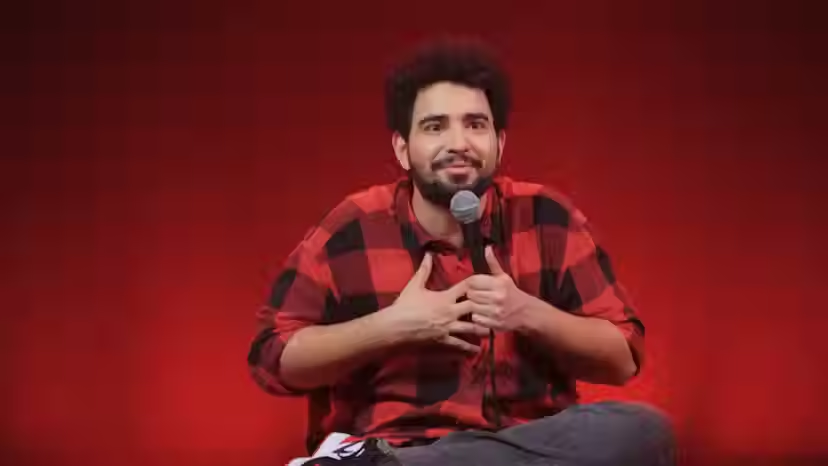
The political machinery of Mumbai has hit a fascinatingly regressive milestone. In the wake of an online firestorm involving comedian Pranit More, audience crowd-work clips, and deeply objectionable viral statements, Mumbai Mayor Ritu Tawde has taken the ultimate, heavy-handed bureaucratic shortcut. Announcing plans to write to Maharashtra Chief Minister Devendra Fadnavis, the Mayor has called for a total, blanket ban on stand-up comedy shows, claiming the art form "spoils today's children" and misuses the constitutional right to freedom of expression.
It is entirely possible and often factual to acknowledge that the modern comedy stage can be co-opted. We have all seen instances where the microphone is picked up by individuals who do not share foundational nationalist sentiments, or who push hyper-radical, performatively edgy, and cynical satire under the guise of humor. But responding to structural lapses in taste with state-enforced, overarching prohibition is not in the interest of a mature, democratic society.
In an era of hyper-industrialization, mass anxiety, and grueling macroeconomic pressures, a state needs its safety valves. To put it bluntly in historical terms: a regime requires its circuses to keep the public emotionally regulated and sedated. Imposing structural policy to silence a vernacular podium only functions to make a governance framework appear needlessly authoritarian. Coming across as heavy-handed and dictatorial is a dangerous tactical error that can easily be weaponized by the political opposition to fuel an anti-incumbency revolt, particularly given the rapid rise of decentralized, digitally powered resistance movements like the Cockroach Janta Party.
Furthermore, if the political class is genuinely concerned about the moral fabric of our youth, they are targeting the wrong stage entirely. The viral uproar over a young man’s stand-up bit lamenting a ₹370/- chicken biryani date is a prime example of political misdirection. That joke wasn't toxic; it was a deeply poignant, modern lamentation on the hyper-commodification of the dating industry.
If the state truly wishes to preserve social integrity and prevent societal collapse, the target shouldn't be comedians the real ban should be on predatory dating apps. Eliminating these algorithmic meat markets would humanize the partnering experience, allowing traditional, community-supported courtship frameworks to take hold once again. A return to organic pairing would not only safeguard Indocentric culture, but it would also directly address dropping birth rates, boost local commerce, and revive the physical "third spaces" where genuine human socialization occurs thereby curing the systemic loneliness epidemic and isolationism plaguing our youth.
The Economics of the Talent Pipeline
Beyond the sociopolitical dynamics, Mayor Tawde's reactionary stance betrays a profound blindness to the modern commercial backend of Indian entertainment. Over the last decade, the Indian stand-up comedy circuit has evolved from an underground subculture into a multi-crore incubator for the broader creative economy. Cultural Monoliths vs. Living Evolution
To claim that stand-up comedy is fundamentally inconsistent with "Indian culture" is an exercise in historical illiteracy. Indian culture has never been a static, delicate monolith; it is an evolving civilizational matrix that has metabolized satire, subversion, and performative humor for millennia.
One needs only to look at the rich heritage of Maharashtra itself. The state's legendary theatrical and cinematic lineage—populated by beloved icons of Marathi cinema—thrived precisely because of an impeccable sense of comic timing and sharp social commentary. Pioneers like the legendary P. L. Deshpande were packing auditoriums with solo, spoken-word comedic performances as early as the 1960s. Modern stand-up is not an imported virus; it is the logical, digital-age evolution of traditional performing arts.
As the political leader of Mumbai—a premier global financial capital and the absolute epicenter of the nation’s pop culture industry—the Mayor should be the first to safeguard these creative spaces. Mumbai’s media infrastructure serves as the country's most potent soft power asset on the geopolitical stage. Bluntly amputating an entire creative ecosystem because a few practitioners overstepped the bounds of public decency is remarkably short-sighted.
National interest and civilizational dignity must always remain top priorities. If a performer crosses the line into genuine hate speech, obscenity, or illegal instigation, the law provides ample instruments to address it on a strict, case-by-case basis. But painting an entire industry with broad, puritanical strokes is a tactical blunder. We cannot treat an entire artistic community as anti-national threats. It is time for corporate cities to be governed with sophisticated, long-term vision, rather than the reactive, knee-jerk anxieties of a bygone era.


Comments