
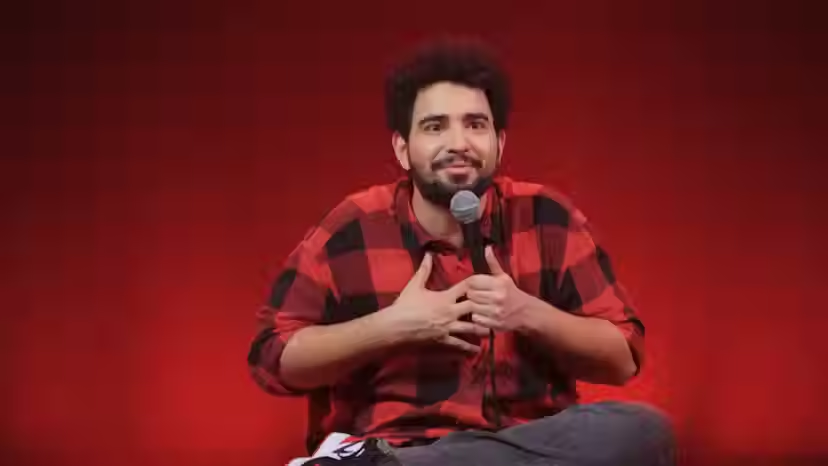


Is Bigg Boss Basically the Hunger Games?

Every year when Bigg Boss ends, I ask myself the same existential question I usually reserve for my dating life: was all this drama necessary? But Season 19 was different. It felt like a shift in the matrix. No predictable showmance that fizzles out by the wrap party. No forced love angle shoved down our throats by the makers. No dramatic torture task meltdown that sparks a human rights debate on Twitter. Instead, we got a winner who redefined the game. Gaurav Khanna, the quintessential TV Heartthrob known for Anupamaa, stayed calm even when the house was collectively losing its mind. He was the "calm in the chaos," proving that sometimes the loudest noise you can make is silence. This season didn’t just break the template. It made a fresh one. And looking back, the parallels to Panem are disturbing.

The Tributes (The Cast)
The cast brought diverse personalities contributing diverse energy, creating a cocktail of chaos that felt suspiciously curated.
The TV Heartthrob (and Winner) Gaurav Khanna.

Usually, the "chocolate boy" gets eaten alive in this arena. But GK turned his charm into armor. He didn't just survive the game; he outlasted the noise by refusing to scream over it.
The Singer: Amaal Mallik.

He successfully turned daily chores into a background score. If you’ve ever wanted a cinematic soundtrack to dishwashing, this was your season. Though, his constant singing (and the breathing machine for his sleep apnea) managed to irritate the living daylights out of his housemates.
The Peace Activist: Farrhana Bhatt.

The Kashmiri actress and self-proclaimed "peace activist" who, ironically, had the most fights this season. She became the season’s "villain," locking horns aggressively with Amaal and Baseer, proving that the road to hell is paved with "please calm down" gestures.
The Spiritual Influencer: Tanya Mittal.

She believed she was better, richer, and decidedly more "zen" than everyone else. Between claiming she had 150 bodyguards and a lift inside her kitchen, she acted as if she was allergic to tap water and common sense.
The YouTuber: Mridul Tiwari.

He came in with an insane fan base and zero game. A classic case of "digital fame doesn't translate to survival skills," he fizzled out early despite the hype.
The Scriptwriter: Zeishan Quadri.

The man famous for writing Gangs of Wasseypur couldn't script his own journey properly. In a twist of poetic irony, the professional storyteller got lost in the reality show narrative and faced a mid-week eviction shocker.
The Cornucopia
You would think we are calling it The Hunger Games because they had fights related to food almost every day. Well, yes. If the original had the Cornucopia, Bigg Boss 19 had the kitchen.
There was a daily food fight that felt less like a meal prep and more like a tactical siege. Someone was offended about the spoons. Someone accused someone of making a smaller portion of halwa (a capital offense in the BB house). One contestant snatched a plate during a fight; another smashed one. Half the season could be summarized as “who is chopping onions and why are they crying is it the onions or the existential dread?”
The Capitol
Yet the real hunger wasn’t for food. It was fame. The audience you, me, the "Janta" we are the Capitol. We watch the spectacle, vote on our phones, and decide who gets the "parachute" of safety and who gets thrown to the wolves. Some created muddas out of thin air just to keep us entertained. One person shared heartfelt stories with the audience through the camera, breaking the fourth wall, but refused to repeat them to actual humans inside. Another invented a life story so dramatic even the synthetic trees in the garden area looked confused.
The Verdict
Everyone wanted attention, screen time, edits, hashtags, followers. Relevance was the new ration. And hunger makes people behave unlike themselves. Would you act normal if you were trapped inside a house with zero outside contact, constant surveillance, and twelve people who all think they are the main character? Or would you also storm out of the living room because the parathas were “not giving respect”? So maybe Bigg Boss is The Hunger Games after all. Not because people starve, but because people crave. Not because they fight to survive, but because they fight to be seen. As the finale lights faded, I couldn’t help but wonder. In a world obsessed with attention, are we all just tributes chasing our own little victories?
Frequently Asked Questions (FAQs)
Why is Gaurav Khanna called the "TV Heartthrob" of Bigg Boss 19?
Gaurav Khanna (GK) earned the title of "TV Heartthrob" due to his immense popularity from the show Anupamaa and his charismatic, calm demeanor inside the Bigg Boss house. Unlike the typical aggressive winners, GK won hearts by maintaining dignity, fitting the archetype of the beloved victor who wins over the "Capitol" (the audience) without resorting to cheap tactics.
How is Bigg Boss Season 19 similar to The Hunger Games conceptually?
Bigg Boss shares psychological parallels with The Hunger Games through the concept of forced cohabitation, resource scarcity (ration tasks), and the "survival of the fittest" narrative. In Season 19, participants like Zeishan Quadri and Mridul Tiwari were removed from their comfort zones and forced to compete for the favor of the audience to ensure their survival.
Why was Abhishek Bajaj nominated for the entire season?
Abhishek Bajaj became the "Perpetual Target" of Season 19, suffering a twist where he was nominated for the duration of the show. This mirrors the "Public Enemy" trope in survival games, where a strong contender is handicapped by the system to test their endurance. His ability to survive despite this disadvantage became a key storyline.
Did the "Hunger for Fame" affect the gameplay of influencers like Mridul Tiwari and Tanya Mittal?
Yes. As noted in the article, "Relevance is the new ration." Digital stars often enter reality shows for the "Clout Economy"—expanding their hashtags and reach. However, Mridul Tiwari’s early exit proved that a massive pre-existing subscriber base does not guarantee survival inside the house if the contestant lacks social adaptability or "game."
Who was the "Villain" of Bigg Boss Season 19?
Ironically, the self-proclaimed peace activist, Farrhana Bhatt, emerged as the season's antagonist. Her aggressive arguments with Amaal Mallik and Baseer contradicted her label, creating a disconnect that the audience (and the cameras) fixated on, making her central to the season's conflict arc.


Comments