

Godzilla Minus Zero Makes History With $31.6 Million. Why Do We Love Monster Movies So Much?

I want to start with a question, not a number.
Why does a 50-metre radioactive lizard make grown adults cry?
Because that's what Godzilla films do now. People leave Godzilla Minus One with wet eyes. And this weekend, millions of people paid to feel that again.

First, the record
Godzilla Minus Zero opened to $31.61 million in North America.
It's a record for a live-action foreign-language film in North America.
It's a record for distributor GKIDS, whose previous best was The Boy and the Heron, at about $13 million.
A record 74% of the money came from premium formats, with $12 million from IMAX alone, according to Deadline.
The global total is around $63 million, and Deadline ranks it the number one film in the world this weekend.
All of that, on a reported budget of around $15 million.
One important note on "records". Anime plays in a different league. Demon Slayer: Infinity Castle opened to $70.6 million in North America last year. So foreign-film records come in tiers, and the live-action tier is the one Godzilla just took.
So why do we love monster films?
Here's where it gets interesting. Monster movies aren't really about monsters. They're about us.
1. The monster is always a real fear
The original Godzilla came out in 1954, less than a decade after Hiroshima and Nagasaki. That same year, an American hydrogen bomb test contaminated the crew of a Japanese fishing boat, the Lucky Dragon No. 5. Godzilla wasn't just a creature. He was the bomb, walking.
Every great monster film works this way. The monster gives a shape to something too big to look at directly: war, nuclear power, climate disaster, grief. Minus One used Godzilla to talk about post-war Japan and survivor's guilt. That's why it made people cry.
2. We enjoy being scared, safely
Psychologist Paul Rozin has a name for this: "benign masochism". It's the pleasure we get from negative feelings when we know we're actually safe. Chilli that burns. Rollercoasters. Sad songs. And monster movies.
Your body reacts as if the threat were real. Your brain knows you're in seat F12 with popcorn. That gap is the thrill.
3. Fear can be practice
Researcher Coltan Scrivner and colleagues found that fans of horror films showed greater psychological resilience during the early COVID-19 pandemic. One idea is that scary stories act like rehearsal: we practise handling fear in a story so we're a little better at it in life.
4. Size makes us feel small, in a good way
In 1757, philosopher Edmund Burke wrote about the sublime: the mix of terror and awe we feel in front of something vast and powerful, like a storm or a mountain. Godzilla is the sublime with scales.
Psychologists who study awe describe something similar, a feeling of a "small self". Standing in front of something huge makes our everyday worries shrink. That's a strange kind of relief.
5. The monster brings people together
In many kaiju films, the monster forces humans to stop fighting each other and work together. Strangers become a team. That's deeply comforting, especially when real life feels divided.
Why the big screen matters
This is where the box office and the psychology meet. 74% from premium formats. People didn't just want to see Godzilla. They wanted to feel the size of Godzilla, in IMAX, with the sound shaking the seats.
You can't get the sublime on a phone screen. That's why this film is a theatre event.
The India connection
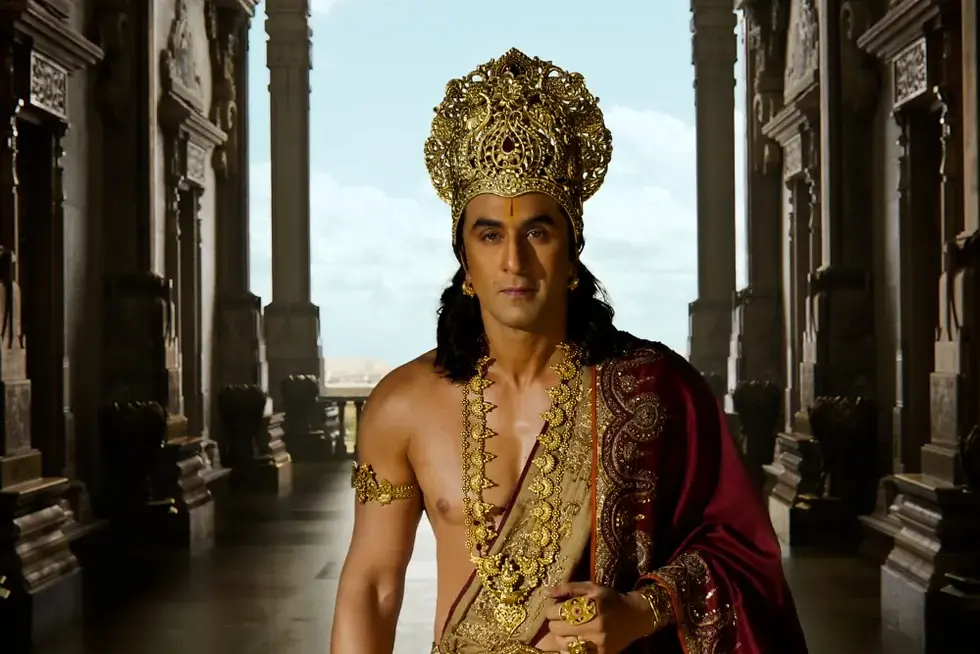
The same weekend Godzilla ruled North America, Ramayana ruled India, and both are stories about something enormous and ancient: a monster, a demon king, a war that's bigger than any one person.
Maybe that's the deeper reason. In uncertain times, we want stories that are bigger than us, and that still end with people standing together.
My take
Godzilla is 72 years old and still finding new ways to scare us and move us. That's not nostalgia. That's a myth doing exactly what myths are for.
Read our first look at Godzilla Minus Zero's opening day, and the Ramayana Diwali-day record.
Frequently asked questions
How much did Godzilla Minus Zero make in its opening weekend?
It opened to $31.61 million in North America and about $63 million globally.
Is Godzilla Minus Zero a record?
Yes. It is the biggest North American opening for a live-action foreign-language film, and the biggest for distributor GKIDS, ahead of The Boy and the Heron's roughly $13 million.
Why do people love monster movies?
Monster films let audiences feel fear, awe and even grief in a safe space. Researchers describe enjoying negative feelings in a safe context as 'benign masochism', and monsters often stand in for real fears such as war or disaster.
What does kaiju mean?
Kaiju is a Japanese word usually translated as 'strange beast', and refers to giant monster films like Godzilla.
What was the original Godzilla about?
The 1954 original was made in the shadow of the atomic bombings of Hiroshima and Nagasaki and a 1954 hydrogen bomb test that contaminated a Japanese fishing boat. Godzilla was a symbol of nuclear terror.
Vishal Waghela is the Co-Founder of AltBollywood and a proud neo-generalist who refuses to pick a lane. Film, music, memes, fashion, AI, internet subcultures: if pop culture touches it, he's already three rabbit holes deep. He writes the way he lives online, loud, emotional, a little chaotic and always honest about why culture makes us feel things. Come argue with him on Instagram at @vishal.waghe1a.


Comments