
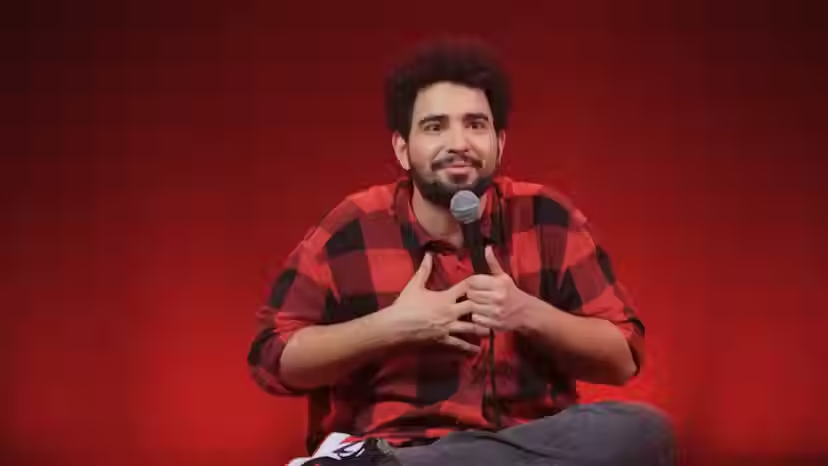


Every Pop Culture Reference You Missed in Mortal Kombat II (2026)

Mortal Kombat II isn’t just about fatalities and fan‑service for gamers – it’s a full‑blown pop culture mixtape, with Johnny Cage as the franchise’s new meme lord and a screenplay that keeps riffing on movies, TV shows, and even Karl Urban’s own career. If you felt like you were laughing at jokes without catching all the layers, you probably were. This breakdown focuses only on pop culture nods – not the pure game‑lore easter eggs – so it works both for casual viewers and deep‑dive article readers.
Johnny Cage: Walking, Talking Pop Culture Machine
Critics are unanimous on one thing: this is Johnny Cage’s movie, and he’s weaponized as a one‑man reference generator. Karl Urban plays him like a burnt‑out Deadpool without the mask – washed‑up, hyper‑self‑aware, and constantly comparing Mortal Kombat’s madness to other movies and shows. In‑universe, Cage is a ’90s action relic: a former VHS‑era martial arts star whose career has cratered so hard he’s doing the convention circuit just to survive. The movie builds half its pop culture commentary around that washed‑up celebrity energy.

The Jean‑Claude Van Damme DNA
Johnny Cage has always been modeled on Jean‑Claude Van Damme, but Mortal Kombat II finally stops pretending and leans into it.
Reviews describe this version of Cage as a “Jean Claude Van Damme‑ish star of crappy ’90s action movies” whose best days are decades behind him.
His whole persona – split‑kick swagger, cheesy movie titles, oversized ego – reads like a mash‑up of Van Damme and other old‑school video‑store martial artists.
For anyone who grew up on Bloodsport, Kickboxer and straight‑to‑VHS actioners, Cage’s entire character becomes one big nostalgia reference, not just a nod to the games.
Citizen Cage: The Meta Flop Joke
The 2021 movie ended with a blink‑and‑you‑miss‑it poster for Citizen Cage, a fake Johnny Cage movie that doubled as a tease for his arrival. Mortal Kombat II turns that throwaway easter egg into an ongoing joke.
Cage is introduced as the guy whose Citizen Cage era is long gone. He’s living off autographs of films nobody really respects anymore.
One review points out that Johnny himself jokes that rebooting Citizen Cage would be a terrible idea, which is a meta gag about his own failed filmography.
You’re not just laughing at a fake title – you’re laughing at Hollywood’s obsession with reboots, via a fictional actor who knows his big “classic” honestly wasn’t that good.
Uncaged Fury: Mission: Impossible Poster Parody
Look closely at one of Johnny’s posters: Uncaged Fury. It’s not just a background prop – it’s a direct parody of the original 1996 Mission: Impossible poster.
Side‑profile hero shot? Check.
Cool blue, spy‑thriller gradient background? Check.
Minimalist title layout that screams mid‑’90s VHS cover? Also check.
The visual language is pure Tom Cruise spy blockbuster, but the face is Johnny Cage with yet another punny title. It’s a visual meme aimed squarely at ’90s kids who remember that exact VHS art from rental shelves.
Deadpool‑Style Meta Humour (Without Breaking the Wall)
Multiple outlets call Cage’s schtick “Deadpool‑esque,” and not by accident.
He fires off non‑stop movie and TV references in the middle of fights, narrating the insanity around him like a pop‑culture commentator rather than a solemn chosen warrior.
The tone is extremely meta – he’s treating a literal fight for Earthrealm like a bad sequel, a reboot pitch, or a failed franchise crossover.
The big difference: he doesn’t fully break the fourth wall. The film keeps him technically in‑universe, but all his references are calibrated for the audience watching outside.
The “Big Trouble in Little China” Jab at Raiden
One of Cage’s best lines is aimed at Earthrealm’s protector himself. At one point, he looks at Raiden and basically calls him a “Big Trouble in Little China cosplayer.”
Why it hits:
John Carpenter’s Big Trouble in Little China (1986) is one of the core spiritual ancestors of Mortal Kombat: ancient Chinese deities, lightning‑god visuals, an American loudmouth stumbling through mystical battles.
By name‑dropping it, the movie openly admits the influence that’s been there since the ‘90s arcade days.
It’s not just a joke – it’s the franchise finally saying, “Yes, we know you’ve been thinking this for 30 years.”
Squid Game: The Tournament as a Murder Party
When Cage compares the Mortal Kombat tournament to a “Squid Game murder party”, the reference does a ton of heavy lifting.
For non‑gamers, Squid Game is the fastest way to explain: surreal game structure, brutal elimination, people dying in rounds over opaque rules.
It plugs Mortal Kombat straight into the modern death‑game trend that runs from Battle Royale to The Hunger Games and now to Netflix.
It’s also the franchise confessing that, yes, this is basically the prestige‑TV version of what it’s always been: stylised, gamified mass murder.

John Wick and the Death of ’90s Martial Arts Movies
One of the sharpest pop culture blocks comes in a quiet bar scene. Johnny Cage, beer in hand, laments that audiences now prefer violent, grounded action like John Wick over the cheesy wire‑fu era he represents.
He outright references John Wick‑style fights as the new gold standard.
He positions himself as the dinosaur whose flashy, obviously staged martial‑arts cinema has been eclipsed by grim, gun‑fu realism.
This isn’t just a name‑drop; it’s Mortal Kombat II doing commentary on how action cinema evolved – and how nostalgia films like this have to fight to stay relevant.
LOTR Meta Jokes: Karl Urban Roasting His Own Résumé
Karl Urban is already a geek‑culture legend – The Lord of the Rings, Star Trek, The Boys – and the film doesn’t leave that history untouched.
Reviews note that Johnny Cage throws in a few Lord of the Rings jokes, deliberately winking at Urban’s role as Éomer in Peter Jackson’s trilogy.
That means:
The actor is effectively referencing his own past life as a fantasy warrior while now playing a washed‑up action star.
For fans, it turns Urban himself into a walking easter egg – not just his character.
It’s the kind of gag that flies over casual heads but absolutely kills at fan screenings.
Ed Boon’s Bartender Cameo
Stan Lee walked so Ed Boon could pour Johnny Cage a drink.
Mortal Kombat co‑creator Ed Boon appears in a bar scene as the bartender listening to Johnny’s rant about how martial arts movies have changed.
It’s the creator of the games literally tending bar for a character who’s complaining about the decline of the genre he helped shape.
Think of it as the MK equivalent of a Marvel cameo: blink and you miss it, but once you know, it’s impossible not to grin.
Jackie Chan Vibes in the Baraka Fight
At New York Comic Con, journalists were shown a full Johnny Cage vs Baraka sequence – and the first reaction was: “Jackie Chan vibes.”
Coverage describes the fight as leaning into Jackie Chan‑style action comedy: prop gags, tightly choreographed improvisation, and a hero who looks skilled and ridiculous at the same time.
Max Huang (Kung Lao) is a former Jackie Chan Stunt Team member, a detail that quietly reinforces the Chan DNA in the film’s action design.
So even when the movie isn’t naming Jackie Chan out loud, his influence is being used as a cinematic reference language.
Johnny Cage as a ’90s Relic in a 2020s Pop Culture Soup
Multiple outlets frame Mortal Kombat II as a course‑correction from the 2021 reboot – less mythology, more tournament, more fun, and way more Johnny Cage.
Put all the references together, and you get the core joke:
Johnny Cage is a relic from the ’90s, built out of Van Damme, VHS action posters, and cheesy straight‑to‑video titles.
He’s now trapped in a movie universe that acknowledges John Wick, Squid Game, Mission: Impossible, The Lord of the Rings, and past MK movies as the dominant pop culture language.
His every joke – from “Squid Game murder party” to bar‑room Wick complaints – is the script rubbing those two eras together.
Mortal Kombat II ends up less like a straight game adaptation and more like a remix of three decades of action and fantasy pop culture, with fatalities on top.
There’s also a blink-and-you’ll-miss-it meta moment in the movie a sequence where someone yells “Rock On!” at Johnny Cage like he’s still a washed-up cult celebrity from another era. The joke lands even harder once you notice Luke Kenny sitting in the crowd for the screening. For Indian audiences, that is hilariously layered because Kenny himself starred in Rock On!! alongside Farhan Akhtar. It turns the moment into a weirdly perfect cross-cultural in-joke: a fictional action star getting heckled with the title of a real cult music film by an actor who actually lived inside that franchise.



Comments