
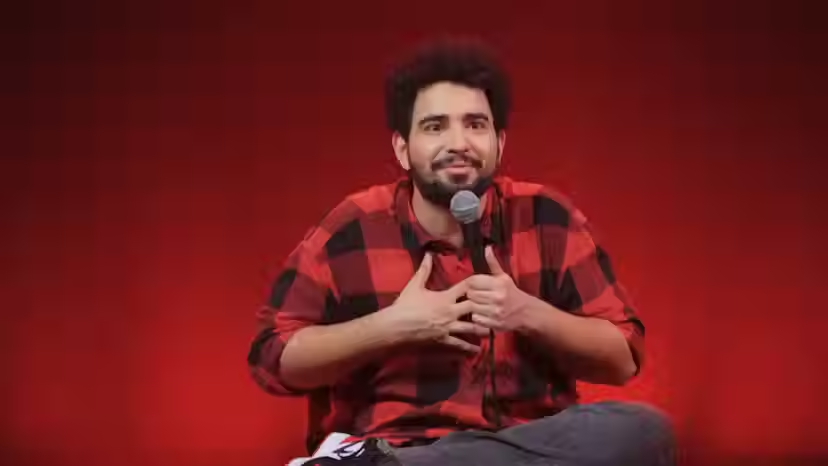


Why Is Gen Z Watching So Much Reality TV? The Answer Is More Than Just Kalesh

Before Bigg Boss clips started taking over Instagram, reality TV already had India in a chokehold. We had TRPs. Voting lines. Newspaper debates. Family arguments over contestants. And that one person who would insist they "don't watch Bigg Boss" while somehow knowing exactly what happened in the previous episode.

So when Gen Z started obsessing over Indian reality TV again, it looked like a new phenomenon.
It really isn't.
From Bigg Boss and Roadies to Lock Upp, Splitsvilla, Desi Bling, The Traitors and whatever new reality format has appeared on your streaming homepage this week, reality TV is clearly having another moment.
But something has changed.
The television screen is no longer where the obsession ends.
You watch an episode. Someone clips the fight. Instagram pushes it onto your feed. Your friend sends it to you with a "BRO????" and suddenly you're searching for the backstory of two people you did not know existed yesterday.
Then come the edits.
Then the memes.
Then the fan accounts.
Then the Reddit theories.
And suddenly, you are invested.
So why is Gen Z so obsessed with Indian reality TV right now?
The answer is a lot more interesting than just saying, "Gen Z loves drama."
It's The Kalesh. Obviously.
Ask a Gen Z viewer why they watch reality TV and the answer will probably be some variation of:
"For the drama."
Fair enough.
But the drama is only the entry point.
The real addiction is everything that happens around it.
A fight happens on Monday.
Someone edits it by Tuesday.
The edit starts trending by Wednesday.
By Thursday, people are debating who was actually wrong, someone has made a fan edit with an unnecessarily emotional song, and three different creators have uploaded videos explaining what "really happened."
You haven't even watched the episode.
You already have an opinion.
For 18-year-old Lakshya Arora from Lucknow, that was exactly the hook.
"I genuinely only heard of it on its launch day, and I just started seeing it because it was all my friends were discussing on the group chats," he says. "And if there's something I can give my opinion on, you best believe I'm not tackling the FOMO."
And there it is.
FOMO might be one of reality TV's most powerful marketing tools.
You don't always watch because you desperately want to.
Sometimes you watch because everyone else already has an opinion.
Nobody wants to be the person asking, "Wait, who is this?" when the entire group chat is analysing a contestant's latest fight.
For Neha Kataria, 21, from Mumbai, Instagram was the entry point.
"I never intended to watch it too, but to be a part of my friends' group discussion, I was forced into watching it, tbh."
The show didn't sell itself to her.
The internet did.
"Honestly, the contestants' edits on Instagram made me watch the series. By the time I started to watch, the series was already trending and more than halfway through. The catfights, mind-boggling revelations, marriages, trauma and dramatic daily soap opera scenes actually made me open Netflix on my device."
This is the new reality TV funnel.

See the clip. Get curious. Join the conversation. Watch the show.
And then comes the real rabbit hole.
The lore.
Exes.
Former best friends.
Old rivalries.
Contestants from previous shows.
Someone who dated someone three years ago.
A contestant who once said something on another reality show that suddenly becomes relevant because they are now sitting across from each other.
The show might give you the episode.
Instagram gives you the universe.
The New Reality TV Celebrity Is Born Online
This is where the current reality TV boom gets really interesting.
Reality TV used to introduce us to strangers.
Now, it often introduces us to people we already know.
Or at least people we've seen 50 times on Instagram without remembering where we saw them first.
Contestants can enter a show with an existing fanbase, a dating history, a controversy, a viral moment, a pile of followers and an internet opinion already waiting for them.
The reality show simply gives all of it a bigger stage.
And from a production perspective, it makes perfect sense.
Someone who is already internet-famous brings an audience with them.
Someone who already has a strong personality online needs less introduction.
Someone who already has drama attached to their name has instant storyline potential.
Reality TV is therefore becoming less of a starting point and more of a career accelerator.
A contestant has a fight.
Someone clips it.
The clip goes viral.
A fan account posts it.
The contestant trends.
People who weren't watching the show start watching.
Followers go up.
Brands notice.
Suddenly, the person who entered as a contestant is now an internet personality.
The entire process can look almost absurdly simple:
Show → clip → viral moment → followers → brands.
The trophy is nice.
The followers are probably more valuable.
And that changes the incentives for everyone involved.
Because the biggest win is no longer necessarily winning the show.
It is leaving the show with an audience.
But Haven't We Been Here Before?
Obviously.
India has been turning reality TV contestants into celebrities for years.
Roadies did it.
Bigg Boss did it.
Reality television has always been a strange little celebrity factory.
The difference today is speed.
Earlier, a reality TV moment lived inside an episode.
You watched it.
You discussed it.
Maybe a newspaper or television channel picked it up the next day.
Now, a contestant can become the biggest conversation on the internet before the episode has even finished airing.
Reality TV has always manufactured celebrities.
Social media just put the manufacturing process on fast-forward.
Think about how many careers have been shaped or accelerated by reality television.
Ayushmann Khurrana first became widely known to a generation of young Indians through Roadies before building a career as an actor, singer and one of Bollywood's most recognisable names.
Ravi Kishan went from films and television to becoming a politician.
The broader point is simple.
Reality TV has never really been just about the show.
For some contestants, it becomes a launchpad.
What has changed is that contestants now have far more control over what happens after the show.
They can build communities.
Create content.
Monetise attention.
Work with brands.
And stay relevant long after the season ends.
Reality TV gives them the audience.
The internet lets them keep it.
Instagram x Reality TV Is A Dangerous Combination
This is probably the biggest difference between the old reality TV era and the current one.
For years, audiences had one primary way of expressing their obsession.
Watch the episode.
Talk about it.
Wait for the next one.
Now, the episode is just the beginning.
You watch.
You screenshot.
You meme.
You make an edit.
You post it.
Someone reacts to it.
Someone else disagrees.
A creator breaks down the argument.
Another creator makes a parody.
Someone digs up an old interview.
And suddenly one 90-second reality TV moment has become 25 pieces of internet content.
The audience isn't passive anymore.
We don't just watch people become famous. We participate in their fame.
A contestant can trend on X, become a meme on Instagram, gain thousands of followers overnight and have fan pages making fancams before the season is even over.
And contestants know this.
They are not performing only for the camera.
They are performing for the clip.
Because the clip can travel far beyond the episode.
This is where reality TV and social media become almost symbiotic.
Reality TV gives Instagram an endless supply of content.
Instagram gives reality TV an endless supply of viewers.
Everyone wins.
Especially the algorithm.
And somewhere in the middle of all this is the world's most reliable content format:
kalesh.
Reality TV Is Basically Content With A Plot
There is another reason reality TV works particularly well in the current internet ecosystem.
It produces an enormous volume of content without needing to constantly invent new characters.
One contestant can provide:
A fight.
A relationship.
A breakup.
A confession.
A reaction.
A meme.
A controversy.
A redemption arc.
A villain arc.
A friendship breakup.
A crying clip.
A funny clip.
A podcast appearance.
A post-show interview.
And probably a brand deal.
The internet loves personalities.
Reality TV produces personalities at scale.
That makes the two mediums almost suspiciously compatible.
And it also explains why recycled contestants keep returning.
The audience already knows them.
They already come with context.
They already have relationships.
They already have enemies.
They already have fans.
The show doesn't have to build the drama from scratch.
It can simply press play.
We Call It Escapism. I Call It A Rabbit Hole.
Perhaps the biggest reason reality TV has survived every change in entertainment is also the simplest.
It feels real.
Yes, we know there is editing.
Yes, we know there are producers.
Yes, we know the format is constructed.
But compared to the incredibly polished digital lives most of us encounter every day, reality TV still offers the illusion that we're seeing something messy and unfiltered.
Gen Z has grown up in an internet landscape where almost everything is curated.
Instagram feeds are curated.
Dating profiles are curated.
Even a supposedly casual photograph may involve several attempts.
Reality TV gives us the fantasy of seeing behind the curtain.
Or at least the fantasy that the curtain has been pulled back.
Someone is crying.
Someone is yelling.
Someone is making a terrible decision.
Someone is saying exactly what they should not say on camera.
And somehow, that feels more authentic than a perfectly edited 15-second Reel.
There is something comforting about watching someone else's life become chaotic when your own day has been painfully normal.
The Reality TV Rabbit Hole Is Very Real
The funniest part is that the obsession doesn't always happen immediately.
Sometimes you genuinely don't care.
Then one reel appears.
Then another.
Then your friend sends you a clip.
You search the contestant's name.
You discover they dated someone else.
Then you discover that person appeared on another show.
Then you find an old clip of them talking about each other.
And suddenly you've spent two hours doing investigative journalism on people whose existence you didn't know about on Monday.
That is the rabbit hole.
For Mahika Bajaj, 25, from New Delhi, the investment could actually work in reverse.
"Sadly, towards the end," she says. "How nonsensical it sounds, right? But when I realise only five or six episodes are left, I lose interest."
Even while questioning the format, though, she was still invested.
And that might actually be the perfect summary of reality TV.
We complain about it.
We call it stupid.
We say we're wasting time.
Then we watch the next episode.
And Then There Is The Nostalgia
Maybe Gen Z's relationship with reality TV isn't completely new-age after all.
Ask Indian reality TV fans about their favourite moments and the answers quickly take you backwards.
SidNaaz.
Dolly Bindra.
Gautami Gulati.
Old Roadies auditions.
Classic Bigg Boss fights.
The moments that became part of Indian pop culture before every single reaction came with a Reel.
There is a reason the nostalgia works.
Reality TV has been part of India's entertainment vocabulary for decades.
The formats may change.
The platforms may change.
The contestants may change.
But the underlying obsession doesn't.
Even the criticism is familiar.
Lakshya points out the constant recycling of contestants, where people who were once the centre of attention on one reality show are brought back into another because their previous relationships already come with built-in drama.
And honestly?
That's probably exactly why it works.
Reality TV has quietly built its own extended universe.
Friendships become rivalries.
Rivalries become content.
Exes become plot points.
Old interviews become evidence.
A contestant's previous reality TV history becomes the lore you need before starting the new season.
The shows aren't only selling new stories anymore.
They're selling existing drama with new episodes.
So, Why Is Gen Z Obsessed With Indian Reality TV?
Because reality TV has figured out something the rest of entertainment is still catching up with. People don't just want to watch stories anymore. They want to participate in them.
Gen Z can watch a contestant on television, discuss them in a group chat, turn them into a meme, follow them on Instagram, argue about them on Reddit and then watch their podcast interview the next day.
The show doesn't end when the episode ends.
The conversation keeps going.
And that is the real transformation.
Once upon a time, becoming a reality TV celebrity meant appearing on television every week.
Then came YouTube.
Then Instagram.
Then short-form video.
Now, one 15-second clip can completely change someone's internet presence.
Voting lines became comment sections.
Fan clubs became fan accounts.
Magazine posters became fancams.
TRP conversations became trending topics.
Episode recaps became Reels.
And the contestant who once waited for an audience to decide their fate can now watch that audience build their career in real time.
So no, Gen Z didn't suddenly discover Indian reality TV.
We just gave the obsession better distribution.
The drama was always there.
The kalesh was always there.
The celebrities were always being manufactured.
The difference is that now, every fight can become a Reel, every Reel can become a trend and every trend can become a career.
And honestly, after spending the entire day dealing with our own lives, watching someone else's fall apart for 45 minutes is apparently the escapism we needed.
Maybe Gen Z isn't obsessed with reality TV.
Maybe Gen Z is just really good at turning reality TV into the internet.


Comments