



What If Indian Sportswear Started Collaborating With Desi Prints?

Step into any urban gym, Pilates studio, or run club from Bandra to Bengaluru, and you are met with an aesthetic monoculture: seamless compression tights in slate grey, moisture-wicking tees in neutral olive, or black-on-black technical shells. Performance wear in India has spent the last decade faithfully mirroring Western and Scandinavian minimalism. It is sleek, sterile, and entirely placeless.

Yet, over on design moodboards and in subcultural streetwear circles, a provocative question has been simmering: What if Indian activewear stopped apologizing for its geographical context? What would happen if a homegrown sportswear brand joined forces with the country's centuries-old artisan textile traditions?
We are not talking about costume-like ethnic wear retrofitted with stretch panels. Picture high-octane technical gear engineered with geometric Ajrakh symmetries, dynamic Kalamkari brushwork, or fractured Bandhani abstractions. As Indian youth redefine what cultural pride looks like on an ordinary Tuesday afternoon, the fusion of ancestral craft and high-performance athleisure feels like the most inevitable, exhilarating fashion frontier on the horizon.
The Identity Pivot: Rooted Everyday, Not Just
on Festivals
For generations, the unwritten wardrobe rule for young Indians was compartmentalization. Western casuals, streetwear, and sportswear were reserved for Monday through Saturday; Indian textiles were locked away in brass-fitted wardrobes until a cousin's wedding or a Diwali puja demanded their emergence.
That boundary has completely collapsed. Gen Z and millennial consumers don't want to wear ethnic clothes merely as traditional protocol. They want cultural resonance baked into their everyday visual identity. They pair vintage silver jhumkas with oversized distressed hoodies, throw printed silk bandanas over boxy workout tanks, and look for garments that feel inherently Indian without feeling stiff or solemn.
By translating traditional motifs into sports bras, biker shorts, training tights, and lightweight runners, brands would bridge the lingering tension between "desi" and "contemporary." It moves heritage out of the display case and into kinetic motion—clothing that breathes through a 5K run and holds its own at a specialty coffee bar afterward.
Blueprint for the Capsule: What the Collections Could Actually Look Like
To make this collaboration visionary rather than touristy, the design language cannot be a lazy copy-paste of a block print onto polyester. It requires a thoughtful synthesis of heritage motifs and functional anatomy:
1. The Ajrakh Speed Suit
The Craft: The ancient block-printing legacy of Kutch and Sindh, known for cosmic geometry, stars, and interlocking trefoils.
The Silhouette: Seamless four-way stretch compression leggings paired with a high-neck zip workout crop.
The Visuals: Deep mineral indigos and madder reds mapped across muscle contours. Instead of a uniform all-over print, the geometric grids align with the natural lines of the hamstrings and obliques, finished with laser-cut ventilation and electric-cobalt flatlock stitching.
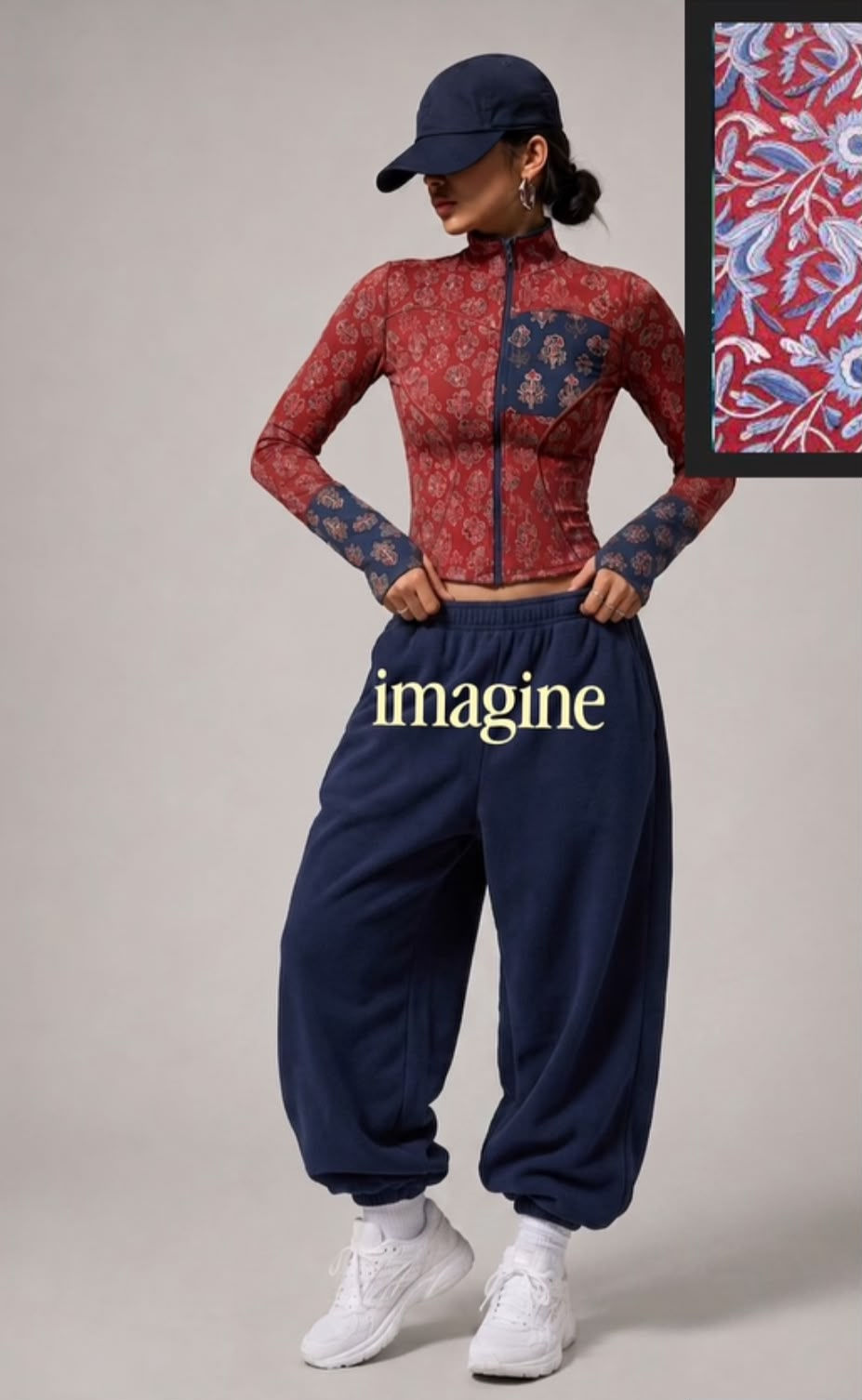
2. The Kalamkari Windbreaker
The Craft: Srikalahasti's free-hand pen drawing, historically depicting flowing mythological landscapes, flora, and mythical fauna.
The Silhouette: An oversized, weather-resistant ripstop shell jacket with adjustable bungee cords and magnetic closures.
The Visuals: Muted parchment tones punctuated by bold black iron-resist line art and earthy ochre swirls. Abstracted motifs of swirling wind and leaping chital deer trace across the shoulder blades, transforming a functional jacket into moving art.
3. The Bandhani Kinetic Runner
The Craft: Tie-dye resist traditions from Gujarat and Rajasthan.
The Silhouette: Lightweight training shorts over compression liners, paired with a hybrid trail-running sneaker.
The Visuals: Disrupted, macro-scaled tie-dye clusters in acid yellow and deep forest green. The traditional speckles are distorted digitally to evoke motion blur, while the sneakers feature embroidered Kantha-inspired reinforcement stitches along high-wear zones.
The Business of Craft: Scarcity, Soul, and Global Desirability
From a brand strategy perspective, an activewear-meets-artisan capsule is a commercial goldmine for domestic labels fighting international athletic giants. Homegrown brands cannot out-spend global sportswear behemoths on generic athletic endorsements. What they can do is own cultural specificity.
High-Impact Drop Culture: Rather than perennial mass production, artisan activewear thrives on limited, numbered drops. Much like streetwear giants driving frenzy through scarcity, limited-run collections generate instant organic hype and collector value.
The Creator-Led Aesthetic: Imagine launch campaigns lensed in the arid salt flats of Kutch or the stepwells of Rajasthan, featuring parkour athletes, yoga practitioners, and contemporary dancers alongside multi-generational artisan families. It bypasses generic gym mirrors in favor of visually arresting, fashion-forward storytelling that dominates Pinterest boards and Instagram feeds.
Global Export Potential: The international market is already fascinated by Indian craftsmanship. Framing our textile heritage through an elite athleisure lens elevates it from quaint handicraft souvenir to world-class design collectible.
The Verdict: Activewear With a Pulse
Athleisure has long functioned as a global uniform of comfort, but it has suffered from an acute lack of imagination. By infusing the kinetic lines of modern sportswear with the tactile soul of Indian textile traditions, homegrown brands have the opportunity to create something genuinely unprecedented.
It is athletic apparel that acknowledges where we come from while keeping pace with where we are running. When performance meets provenance, sportswear stops being just gym gear—it becomes living culture.
Quick Facts: Desi Prints Meet Modern Sportswear
The Core Concept: Merging traditional Indian textile crafts (Ajrakh, Kalamkari, Bandhani, Kantha) with high-performance activewear silhouettes.
Target Demographic: Young, design-conscious Indian consumers who value cultural identity in their daily wardrobe over sterile western minimalism.
Key Silhouettes: Muscle-mapped compression sets, technical ripstop windbreakers, Kantha-stitched running sneakers, and breathable athleisure layers.
Strategic Business Advantage: Differentiation from global athletic incumbents through limited-edition cultural drops, localized storytelling, and global artisan prestige.
Ethical Collaboration Imperatives: Direct artisan royalties, intellectual credit, preservation of sacred symbols, and sustainable material innovation.
Frequently Asked Questions (FAQs)
Can traditional Indian printing techniques like Ajrakh or Kalamkari work on technical gym fabrics?
Yes, through modern fabric innovation. While traditional hand-block printing was limited to cotton and silk, brands can either adapt eco-friendly water-based dyes to sustainable technical blends (such as bamboo lyocell, recycled nylon, or modal) or utilize high-precision sublimation printing that faithfully preserves artisan hand-drawn imperfections while maintaining stretch and sweat-wicking properties.
How is this trend different from conventional Indo-Western fusion wear?
Traditional Indo-Western fusion usually involves adding ethnic touches to formal or casual wear (like wearing a blazer over a kurta or pairing a crop top with a lehenga). This concept takes functional, high-stress sportswear—running tights, sports bras, and technical outerwear—and integrates ancestral geometric motifs directly into performance architecture.
How can sportswear brands avoid cultural appropriation when using regional prints?
By avoiding tokenistic pattern theft. Brands must collaborate directly with certified artisan clusters, provide formal design credit on the garment labels, compensate craftspeople with recurring sales royalties, and respect the cultural and religious context behind specific regional motifs.


Comments