



The Terrifying Vishvarupa: How Ancient Artists Captured Krishna's Cosmic Form

When you walk into a standard Hindu household or look at popular calendar art, the depiction of Lord Krishna is almost universally soothing. He is the divine infant stealing butter, the romantic youth playing the flute on the banks of the Yamuna, or the calm charioteer guiding his friend through a battlefield. The aesthetic is explicitly designed to be approachable.
However, if you actually read the primary text of the Bhagavad Gita, this comforting aesthetic is violently shattered.
On the battlefield of Kurukshetra, the warrior prince Arjuna makes a massive request. He asks to see Krishna's true, unmasked cosmic reality. Krishna warns him that human eyes cannot handle the sight, so he grants Arjuna Divya Drishti (divine vision). What follows is not a vision of peace. It is an overwhelming, paralyzing encounter with absolute infinity, known as the Vishvarupa.
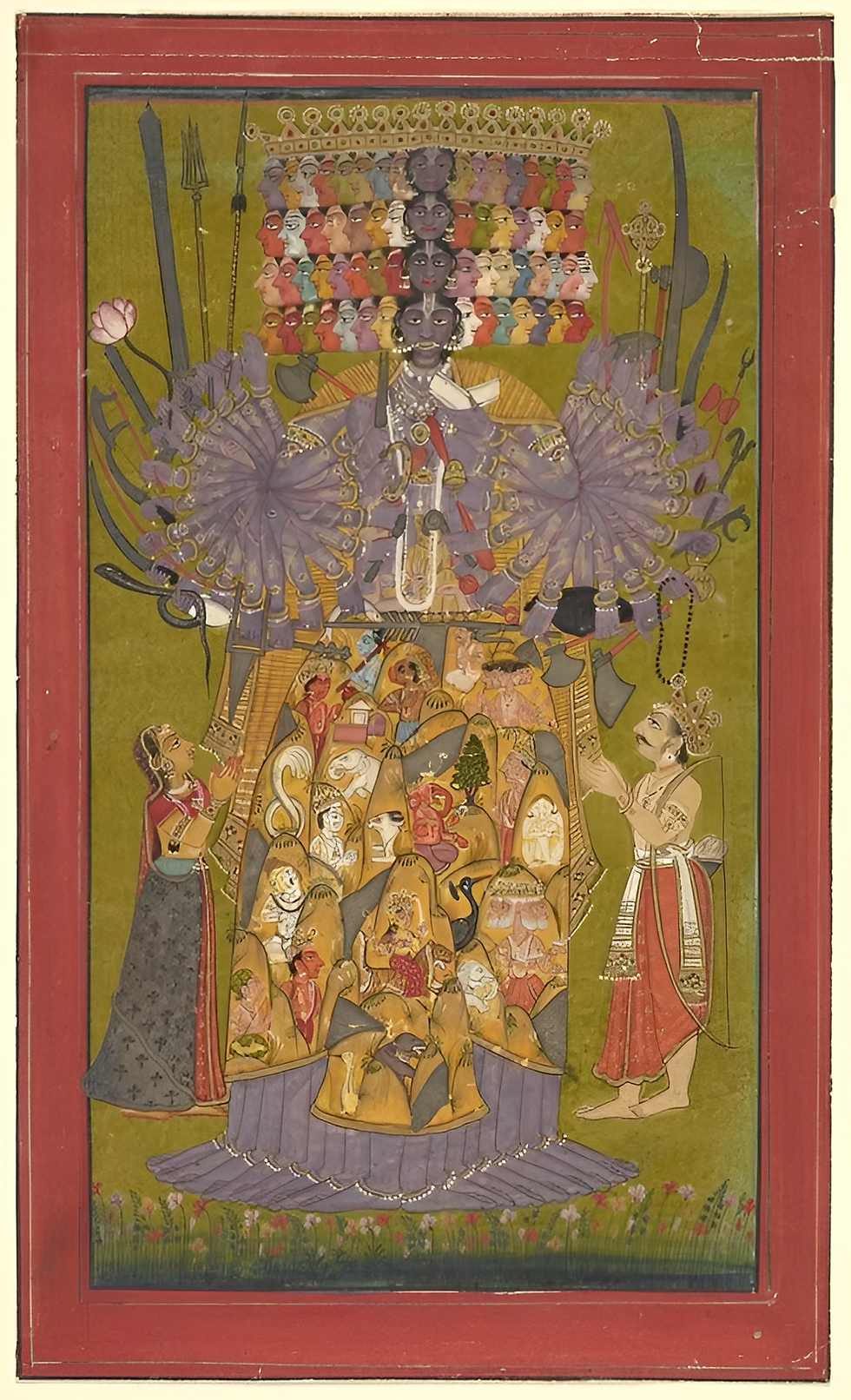
For centuries, capturing the sheer scale and terror of this form has been the ultimate test for Indian artists. To understand the profound philosophical weight of the Vishvarupa, we have to look at the historical evolution of Indian art and how an eighteenth-century artist from the Punjab Hills created a masterpiece of theological storytelling.
The Panic Of Arjuna In Chapter Eleven
To appreciate the art, you must first understand the textual description from Chapter 11 of the Bhagavad Gita that the artist was working from. When Arjuna receives his divine vision, he is instantly pushed to the absolute edge of his sanity. As Krishna abandons his human form and becomes the cosmic creator, universal sovereign, and Kala, who is both time and death, the sight is nothing short of paralyzing.
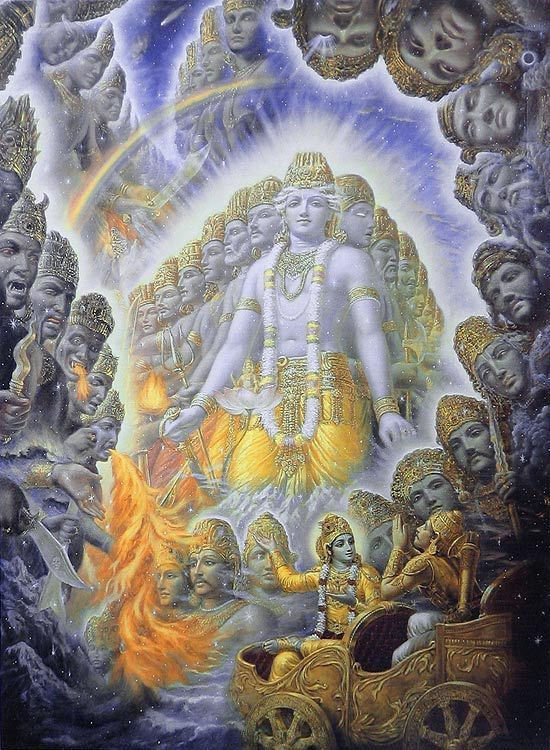
Arjuna does not see a blue-skinned man standing on a chariot. He sees an entity that embodies all of time and all phenomena, an existence that is inherently overwhelming and terrifying. He watches in absolute horror as all the great warriors of the battlefield are sucked into Krishna's flaming mouths, specifically noting how the deity's mouths are spiky with fangs, crushing the heads of kings.
Paralyzed by fear, as the hair on Arjuna's arms bristles in terror, he asks the entity who he truly is. The entity replies with one of the most famous Sanskrit shlokas in human history:
kālo 'smi loka-kṣhaya-kṛit pravṛiddho
lokān samāhartum iha pravṛittaḥ
"I am Kala (Time), the great destroyer of worlds, and I have come here to destroy all people."
The Vishvarupa is the ultimate realization that God is not just the creator. God is also the unstoppable force of entropy that will eventually consume everything in existence.
The Historical Evolution Of The Cosmic Form
Long before the 18th century, ancient Indian artists struggled to depict this overwhelming concept. The earliest physical representations of the Vishvarupa date back to the Mathura school of art during the Gupta period (around the 5th and 6th centuries CE).
These early stone sculptures were highly rigid. To show that Krishna contained the entire universe, sculptors would take a central human figure and carve the faces of his animal avatars (like the boar Varaha or the lion Narasimha) protruding stiffly from the sides of his head. They would carve tiny figures of other gods into the stone halo behind him. While historically significant, these stone carvings were static. They felt like a mathematical diagram of theology rather than a living, breathing, terrifying cosmos.
The true visual revolution occurred centuries later, high in the foothills of the Himalayas. The Rajput courts of the Punjab Hills birthed the Pahari miniature painting tradition. Armed with handmade paper, incredibly fine squirrel-hair brushes, and vibrant mineral colors, these artists broke free from the rigidity of stone. They realized that the Vishvarupa was not a static statue; it was a dynamic, violently swirling force of nature.
The Masterpiece From The Kingdom Of Bilaspur
Around the year 1740, an anonymous eighteenth-century artist from the kingdom of Bilaspur, in the Punjab Hills, sought to evoke this limitless and proliferating universe. Operating at the peak of the Pahari miniature tradition, this artist created a painting that currently serves as one of the greatest theological illustrations in Indian history.
To convey the infinite, mechanical reality of the cosmos, the artist extended Krishna's sixty multicolored heads and forty-four pinwheeling arms to the very borders of the painting. Four of Krishna's heads, shaded the same lavender-blue as his body, are vertically stacked at the center of his body. By intentionally cutting the arms off at the absolute edges of the paper, the artist explicitly tells the viewer that the form continues infinitely outward. The paper is merely a window into something boundless.
In the lower-left corner of the painting, standing at the feet of the cosmic giant, is a tiny figure of Arjuna. His hands are raised in the gesture of worship, looking completely dwarfed by the sheer scale of the entity towering over him.
The Juxtaposition Of Scale
The most brilliant philosophical choice made by the Bilaspur artist is found right at the center of the painting.
Within the golden dhoti that wraps around his waist, a miniaturized mountain landscape conveys-through the juxtaposition of scale-both Krishna's vastness and his supremacy over all other Hindu gods and sages.
This detail is breathtaking. The artist is demonstrating that the entire known universe, including all the powerful deities that humans worship for protection, exists merely as a decorative pattern on the clothing of the Supreme Being. Krishna's vastness is so absolute that the entirety of creation is just a localized, almost trivial detail on his garment.
The Fangs Of Kala And The Softness Of Bhakti
If you look closely at the central stack of Krishna's heads in the painting, you will notice the lowest mouth. Just as Arjuna described in the Gita, the artist painted this mouth open so that it is spiky with fangs. This is the visual representation of Kala, the terrifying consumer of time and death that Arjuna witnessed.
However, despite the presence of the fangs and the infinite, overwhelming arms, the painting does not evoke feelings of horror or dread.
This is where the theology of the artist truly shines. With its delicate line, luscious sherbet colors, and especially Krishna's gentle expressions as he meets the gaze of his devotees, the painting transcends literal illustration of the Gita's eleventh chapter to convey the broader context of bhakti devotion.
During the 18th century, the Bhakti movement (the path of pure, loving devotion) heavily influenced the Rajput courts. The artist knew that the literal text of the Gita was terrifying. But the artist was arguing that through Bhakti, the terrifying mechanical reality of the universe becomes accessible. Krishna's compassion is accessible to all. The terror of the fangs is softened by the sherbet colors of divine love.
The Bilaspur painting of the Vishvarupa survives as a reminder of how sophisticated ancient Indian art truly was. It proves that capturing cosmic scale does not require massive canvases or modern technology. It requires a profound understanding of philosophy, where the terrifying reality of death and the soothing power of devotion are painted onto the exact same face.
FAQ Section
What is the Vishvarupa in Hindu mythology?
The Vishvarupa (Universal Form) is the supreme, infinite, cosmic manifestation of Lord Krishna. It contains all of creation, time, and destruction within a single body. It is most famously revealed to the warrior prince Arjuna on the battlefield of Kurukshetra.
In which chapter of the Bhagavad Gita does the Vishvarupa appear?
The Vishvarupa is fully described in Chapter 11 of the Bhagavad Gita. Arjuna asks Krishna to reveal his true form, and Krishna grants him divine vision to witness the overwhelming spectacle.
Why was Arjuna terrified of Krishna's true form?
Arjuna was terrified because the form was not peaceful. He saw a boundless entity with infinite arms, blazing fire, and terrible fangs crushing the universe. Krishna revealed himself as Kala (Time), the ultimate destroyer of all worlds and people.
How did historical depictions of the Vishvarupa evolve?
Early depictions, such as Gupta-era stone sculptures from Mathura, were highly rigid, adding animal faces to a central human figure to show different avatars. It was not until later traditions, like the 18th-century Pahari miniature paintings, that artists used paper and vibrant colors to capture the dynamic, infinite motion of the cosmic form.
What makes the 1740 Bilaspur painting of the Vishvarupa so special?
The 18th-century Pahari artist successfully conveyed infinite scale by extending Krishna's sixty heads and forty-four arms to the absolute borders of the painting. The artist also painted an entire mountain landscape containing all other gods inside Krishna's clothing, showing that the whole universe is just a tiny detail on his body.
How does the painting contrast terror and devotion?
While the painting includes the terrifying fangs of Time as described in the Gita, the artist used luscious sherbet colors and gentle facial expressions. This theological choice demonstrates that through the path of Bhakti (devotion), the terrifying reality of the cosmos can be experienced as compassionate and accessible.

Comments