



The Puranic Truth: Hidden Ganesha Secrets Nobody Tells You

The hidden Ganesha secrets found deep within the Puranas directly contradict the simplified festival narratives told today. Unlocking these ancient Sanskrit texts reveals a highly complex deity whose origins, avatars, and metaphysical powers span across multiple cosmic cycles and unimaginable forms.
Lord Ganesha is worshipped globally as the remover of obstacles and the god of new beginnings, yet his true scriptural identity remains largely unknown to the masses. The Shiva Purana, Ganesha Purana, Mudgala Purana, and Brahmavaivarta Purana describe a deity who assumes eight distinct avatars, commands an enormous celestial mouse subdued by force, and dictates the martial success of Lord Shiva himself.
1. The Astounding Tale Of The Giant Celestial Mouse

Every popular depiction of the elephant-headed deity features a small, docile mouse sitting quietly at his feet. The modern interpretation often reduces this animal to a symbol of controlling one's restless desires. However, the Ganesha Purana presents an origin story that is considerably more violent and complex. The vehicle was never originally a mouse, nor was it small.
The creature was once Krauncha (Sarus Crane), a powerful Gandharva who moved among the celestial musicians. Through an act of sheer clumsiness, Krauncha accidentally stepped on the foot of the fiercely ascetic sage Vamadeva. The enraged sage immediately cursed the celestial being, but the resulting transformation did not shrink him into a harmless rodent. Instead, the curse mutated Krauncha into an enormous, terrifying giant mouse. Driven by madness and insatiable hunger, this colossal beast began a rampage across the earthly realm. The giant mouse trampled entire agricultural fields, scattered innocent livestock, and eventually caused widespread destruction that threatened the hermitages of the sages.
The deity did not simply select this creature out of convenience or aesthetic preference. He hunted the beast down. In a display of supreme martial dominance, he bound the giant mouse with his divine noose and subdued it through overwhelming force. It was only after being utterly defeated and physically restrained that Krauncha surrendered. Left with no alternative, the former celestial musician begged to become the deity's eternal vehicle, a request that was finally granted. This transforms the docile mouse on the modern mantelpiece into a stark reminder of conquered cosmic chaos.
2. The Real Reason Shiva Couldn't Destroy Tripura

The destruction of Tripura, the three impregnable flying cities of the Asuras, is one of Lord Shiva's most defining martial triumphs. Yet, the Rudra-Samhita within the Shiva Purana (Yuddha-Khanda, Chapter 10) details a fascinating prerequisite to this apocalyptic event. Shiva stood ready in his magnificent chariot, holding the aggressive Pratyalidha martial stance. His bow was fully strung, his divine arrow fixed, and his eyes were locked on the target for a hundred thousand years.
Despite his supreme destructive capability, the three cities simply would not align into the arrow's path. No matter how perfectly Shiva aimed, the target remained elusive. The reason was entirely metaphysical: Ganesha was stationed directly on Shiva's own thumb. A disembodied voice from the heavens then proclaimed the harsh truth. It announced that Shiva would absolutely not be able to destroy the Tripuras as long as the remover of obstacles was not explicitly worshipped first.
Recognizing the cosmic protocol, Shiva halted his martial advance and offered direct worship to him. The moment this protocol was fulfilled and the obstacle-remover was pleased, the cosmic mechanics shifted. The three flying cities instantly merged into a single, strikeable target. Urged on by Brahma and Vishnu, Shiva finally loosed the arrow, reducing the Asuras to ash. Interestingly, the text later attempts to resolve this theological tension by asserting Shiva's supreme independence, refusing to cleanly admit that he succeeded solely by another god's grace. This dual narrative highlights the uncompromising structural necessity of invoking the Pratham Pujya before any endeavor, even for the destroyer of worlds.
3. The Chilling Emergence Of Personified Sin

The Upasana-Khanda of the Ganesha Purana (Chapter 9) contains a deeply visceral account of karma and purification that reads more like cosmic horror than a standard devotional tale. King Somakanta finds himself suffering immensely, physically crushed under the accumulated weight of his own past misdeeds. To cleanse the monarch, the great sage Bhrgu initiates a intense ritual, sprinkling the king with holy water sanctified through the recitation of divine names.
What happens next is not a metaphorical lifting of a spiritual burden. The text describes a small, grotesque, black-faced figure physically crawling out of the king's nostril. Upon exiting the body, this entity instantly swells to an enormous, terrifying scale. It manifests a gaping mouth measuring seven talas wide. Foul substances like pus and blood pour from its jaws alongside blazing fire, and its eyes burn a horrific red. This monster identifies itself as Papapurusha, the literal, living personification of sin.
The demon arrogantly announces that it has been residing inside the king's body all along, feeding on his negative karma. Papapurusha then demands to be fed immediately, threatening to consume the king and every sage present if denied. Unfazed by the horror, Sage Bhrgu uses his profound spiritual authority to banish the creature into a dead mango tree. The sage's pure gaze and physical touch instantly reduce both the tree and the demon of sin to ash. The scripture explicitly uses this terrifying, literal manifestation of sin to underscore the unparalleled purifying power of listening to the Ganesha Purana.
4. The Forgotten Eight Principal Avatars

While the Dashavatara (the ten incarnations of Lord Vishnu) are universally recognized, recited by schoolchildren, and printed on millions of calendars, the parallel avatar system of the elephant-headed deity remains obscure. The Mudgala Purana meticulously outlines eight principal incarnations of Ganesha: Vakratunda, Ekadanta, Mahodara, Gajavaktra, Lambodara, Vikata, Vighnaraja, and Dhumravarna.
This is not a fragmented collection of local folklore hastily stitched together. It is a highly structured, sequential theological framework. Each of the eight avatars is granted its own extended narrative arc, its own specific cosmic opponent (representing different human vices such as arrogance, lust, or anger), and its own distinct reason for manifesting in the material world. For instance, Vakratunda rides a lion to defeat Matsaryasura (the demon of jealousy), while Ekadanta rides a mouse to vanquish Madasura (the demon of arrogance).
The existence of this fully developed, chapter-by-chapter mythological architecture proves that his tradition is as deep and systematic as any other major Hindu sect. Yet, these specific, highly detailed forms are rarely depicted in mainstream pandals or household shrines. The modern worshipper is largely familiar only with the standard, four-armed generic iconography, entirely unaware of the rich, textual universe of the eight avatars that sits explicitly within the very scriptures they revere.
5. The Kalpa-Shifting Mystery Of His Elephant Head

Ask any individual how the deity acquired his elephant head, and they will confidently recount a single, universally accepted narrative: Shiva beheaded the boy in a fit of rage and subsequently replaced the head to appease Parvati. However, the Shiva Purana refuses to let this simplified version stand as the absolute, solitary truth.
In a profound theological dialogue, Lord Brahma explicitly states that due to the cyclical nature of cosmic time (the difference of Kalpas), the story of this birth is told in drastically different ways. He presents two contrasting accounts back-to-back. In one Kalpa, it is the malefic glance of Shani (Saturn) that instantly destroys the infant's head. In an entirely different Kalpa, the narrative shifts to the widely known version where Shiva himself executes the cutting.
The latter version holds peculiar details often glossed over. Parvati, desiring a loyal servant answerable exclusively to her authority, creates a son using the scurf (cleansing paste) from her own body. This immaculate creation occurs completely without Shiva's biological or spiritual involvement. Stationed at the door with a staff, the boy dutifully blocks Shiva's entry. Because the boy does not recognize his own father, and Shiva does not recognize his wife's creation, the boy strikes the great ascetic. Unrecognized and humiliated by a mere gatekeeper, Shiva summons his ganas (troops), escalating the conflict that eventually leads to the famous beheading. The text never attempts to reconcile these differing kalpic stories as contradictions; it accepts them as the fluid, multi-layered reality of cosmic time.
6. The Startling Connection To Lord Krishna

Perhaps the most startling and rarely discussed narrative exists within the Ganesha Khanda of the Brahmavaivarta Purana. This specific text operates on a deeply Vaishnava theology, presenting a birth story that completely redefines the deity's fundamental identity.
According to this scripture, Parvati undertakes an arduous, year-long period of severe austerity and penance specifically to please Lord Krishna. Moved by her immense devotion, Krishna grants her an extraordinary, universe-altering boon. The Sanskrit text states it with absolute clarity: *gaṇeśarūpaḥ śrīkṛṣṇaḥ kalpe kalpe tavātmajaḥ*. This translates to the profound revelation that Krishna himself, adopting the physical form of Ganesha, will become her son, cycle after cycle.
In this specific theological account, the child born to Parvati is not merely an independent creation shaped from clay and animated by her own life force. The boy standing at the threshold, the one who will bravely face the wrath of the gods and eventually undergo the legendary beheading and restoration, is fundamentally Krishna himself wearing an elephant-headed form. This narrative seamlessly bridges the theological gap between the Shaiva and Vaishnava sects, presenting a unified, deeply interconnected vision of divinity that modern retellings have entirely erased.
7. The Deep Vaishnava Reason For The Tulasi Curse

The mythological ban on offering Tulasi leaves during the worship of the elephant-headed god is a strictly observed ritual rule. The origin of this restriction is found in the Brahmavaivarta Purana (Chapter 46), but the complete context of the story is almost always omitted from modern discourse.
The goddess Tulasi, wandering in her divine, exquisite form, encounters the young deity deeply absorbed in intense meditation on the banks of the Ganges. Instantly captivated by his radiant aura, she disrupts his trance and boldly proposes marriage. He firmly refuses her advance. The rejection quickly escalates into a fierce argument, resulting in a mutual exchange of curses. He curses her to be transformed into a plant, while she curses him to eventually marry despite his current vows. He then states plainly that he will never accept her leaves in his worship.
However, the scripture reveals a critical, often ignored detail about his state of mind during this encounter. He did not decline the marriage simply out of a generic vow of ascetic celibacy. The text explicitly describes his mind, in that very moment, as being completely fixated on the lotus feet of Lord Krishna. He was absorbed in a highly specific, directed penance. The scripture explicitly praises him as noble and labels him a true Vaishnava (a supreme devotee of Vishnu). His rejection of Tulasi was not a rejection of love; it was the result of a mind and identity that were already entirely surrendered to another supreme being.
8. The Specific Gesture Of Obeisance To Govinda

The Brahma Samhita (Verse 5.50) presents a visual and theological image that completely disrupts the standard perception of an independent, supreme deity. This foundational text describes Ganadhiraja (the king of the Ganas) in a highly specific, intimately devotional posture.
The verse details the exact moment of offering obeisance, describing him receiving the lotus feet of Govinda (Krishna) directly upon the two prominent frontal lobes of his own majestic elephant head. This is not a casual greeting; it is a profound gesture of submission and reverence. More importantly, the verse directly links this specific act of devotion to his renowned power to destroy obstacles across the three worlds.
The theological commentary attached to this verse expands on this hierarchy. It categorizes him as holding a rank among five deities who possess what is termed a mundane or delegated quality. According to this specific Vaishnava philosophical lens, his immense power to clear paths and grant success is not an independent, self-generated force. Instead, his entire glory and functional capability rest entirely upon the grace of Govinda. This single line ties the very function he is worshipped for directly to his eternal subservience to the supreme godhead, a perspective that drastically alters the dynamics of Puranic worship.
The Astrological Undercurrents Of The Puranic Ganesha
Astrology enthusiasts point to these complex Puranic narratives as symbolic representations of heavy planetary transits and karmic debt. The terrifying emergence of Papapurusha is often viewed through the lens of a severe Saturn (Shani) return or the activation of the 8th house, where deep-seated, hidden karma is violently brought to the surface for necessary purification.
Furthermore, birth chart interpretations suggest that the shifting narratives of his birth across different Kalpas mirror the fluid, ever-changing influence of Rahu and Ketu (the lunar nodes). The mutual curse with Tulasi strongly implies a challenging Venus-Ketu conjunction, where earthly desires are abruptly severed in favor of extreme spiritual detachment. By observing these myths through an astrological framework, the physical events translate into profound psychological and karmic archetypes that dictate human behavior under planetary duress.
The Indian Lens: Why We Forget The Puranas
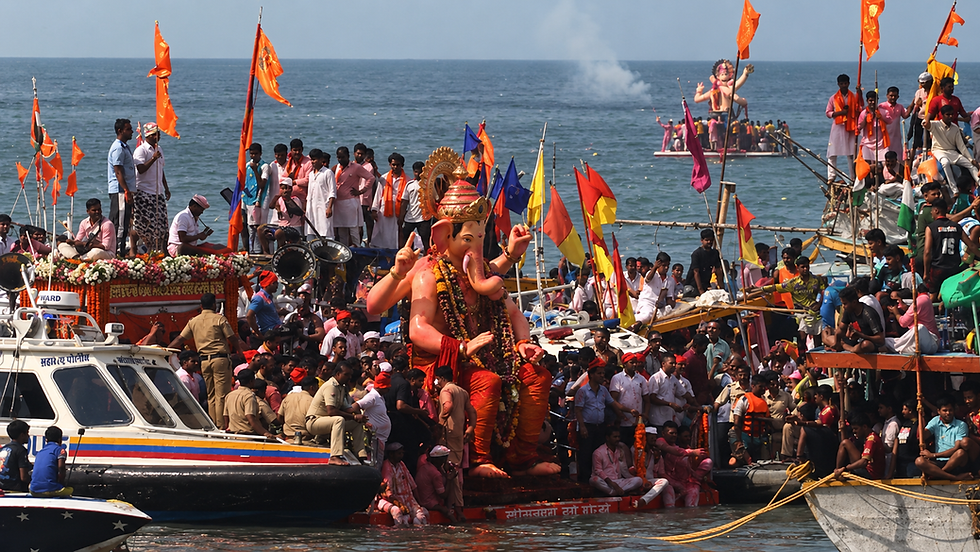
In the contemporary Indian landscape, the festival of Ganesh Chaturthi has evolved into a massive, socio-cultural phenomenon dominated by gigantic pandals, Bollywood music, and community bonding. While this unification is beautiful, it has actively contributed to the erosion of deep textual literacy. The average devotee interacts with the deity purely through the lens of popular folklore and emotional bhakti, completely detached from the complex, sometimes shocking realities preserved in the original Sanskrit texts.
This detachment is partly due to the oral tradition prioritizing the most accessible, family-friendly versions of the myths. Stories of horrific sin demons, giant destructive mice, and inter-sectarian theological subservience are deemed too complex or unsettling for festive celebration. As a result, the deep scriptural heritage of the Mudgala and Brahmavaivarta Puranas is left to academic scholars, while the masses continue to worship a highly sanitized, culturally flattened version of the Pratham Pujya.
The global diaspora has increasingly begun to question these sanitized narratives, searching digital archives and translated texts for the authentic, unfiltered theology of their ancestors. As streaming platforms and digital creators dive deeper into Hindu mythology, the demand for these raw, scripturally accurate stories is slowly beginning to outpace the traditional, simplified folklore.
This immense textual universe proves that the deity invoked before every new venture is not merely a benevolent figure of good fortune. He is a complex, multi-dimensional force who subjugates cosmic chaos, holds the key to Shiva's martial victories, and physically carries the weight of supreme devotion upon his brow.
FAQ
Why does Ganesha ride a mouse?
The Ganesha Purana states he forcefully subdued a giant, destructive mouse named Krauncha (a cursed celestial musician), who then begged to become his vehicle. This represents the conquest of wild, chaotic energy rather than a simple choice of companion.
Why is Tulasi not offered to Ganesha?
According to the Brahmavaivarta Purana, Tulasi proposed marriage to him while he was meditating on Krishna. He refused, leading to a mutual curse where he declared her leaves would never be used in his worship.
What are the 8 avatars of Ganesha?
The Mudgala Purana lists eight principal incarnations: Vakratunda, Ekadanta, Mahodara, Gajavaktra, Lambodara, Vikata, Vighnaraja, and Dhumravarna, each designed to defeat a specific demon of human vice.
Did Shiva behead Ganesha?
The Shiva Purana explains that the story changes depending on the cosmic cycle (Kalpa). In one Kalpa, Shiva beheads him after a fierce battle; in another, the child's head is destroyed instantly by the malefic gaze of Lord Shani.

Comments