



The Myth of “Overacting”: Why Indian Cinema Has Been Judged Through a Eurocentric Lens

For decades, one criticism has followed Indian cinema wherever it has travelled.
“It is over the top.”
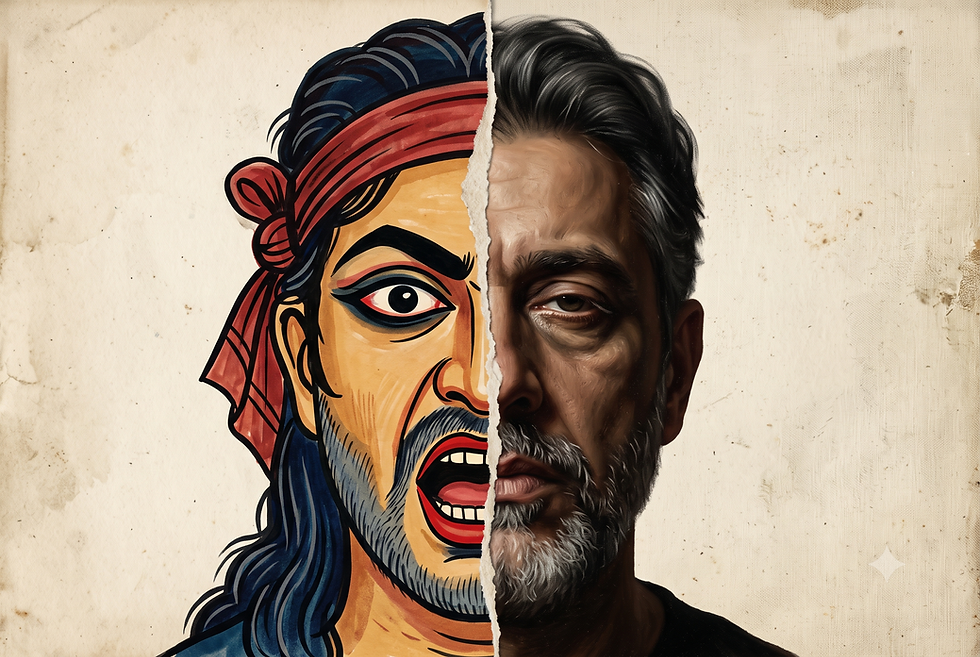
Actors are supposedly too expressive. Faces reveal too much. Emotions are worn too openly. Joy is exuberant, grief is overwhelming, love is unapologetic and anger is unmistakable.
This criticism is repeated so frequently that it has acquired the appearance of objective truth. Yet I would argue that it tells us far less about Indian cinema than it does about the assumptions embedded within the critical frameworks through which Indian cinema has historically been viewed.
The dismissal of Indian performance as “overacting” is, in my view, often an expression of Global North aesthetic chauvinism. It mistakes a historically specific European tradition of performance for a universal standard of sophistication while overlooking the fact that India developed one of the world’s oldest and most sophisticated philosophies of emotional communication centuries before modern cinematic realism emerged in Europe.
The face, in the Indian imagination, has never merely been anatomical.
It has always been philosophical. A Civilisation That Learned to Speak Through Emotion
Long before cinema existed, India had already codified the relationship between emotion, performance and audience.
The Natyashastra articulated the concepts of Rasa and Bhava, describing how facial expression, gesture, movement and voice could evoke profound emotional participation within an audience. The performer’s task was not simply to imitate reality but to transform it into shared experience. This tradition continues through Bharatanatyam, Kathak, Kuchipudi, Yakshagana, Kathakali, folk theatre and ultimately mainstream Indian cinema.

For Indian audiences, the face has long been understood as an instrument of communication. Emotion is meant to be recognised. It is meant to be shared. It is meant to unite performer and audience in a common emotional space.
That aesthetic continuity stretches across millennia. The European Ideal of Restraint
Much of contemporary European and North American screen culture developed within a different artistic lineage. Modern realism frequently celebrates emotional restraint.
A flicker of the eye is praised as profound. A barely perceptible tightening of the jaw becomes psychological complexity. Silence becomes intelligence. Ambiguity becomes maturity. There is nothing inherently wrong with this tradition. The problem arises when it is presented as the universal endpoint of artistic evolution. It is not. It is one cultural language among many. Institutions Shape Aesthetics One plausible socio-anthropological explanation lies not in biology but in institutions. History leaves its imprint upon culture. Political systems influence behaviour. Institutional environments reward particular ways of interacting with other human beings. Societies organised around rigid hierarchy, feudal privilege, imperial administration and colonial governance frequently depended upon discipline, bureaucracy, emotional regulation and strategic control. Such institutions often rewarded caution, reserve and the careful management of visible emotion.

Over generations, those institutional habits can influence wider cultural ideals, including what later comes to be recognised as sophisticated performance. This is not an argument about innate characteristics of any people. It is an observation that institutions often reproduce the behavioural traits they reward.
By contrast, the Indian subcontinent developed within a civilisational framework that placed enormous importance upon public ritual, philosophical inquiry, artistic performance and collective participation. Festivals, temples, storytelling traditions and community life all reinforced emotional communication rather than emotional concealment. The face became an instrument of truth rather than merely an instrument of restraint. Emotional Literacy Is Not Emotional Excess The familiar accusation that Indian actors “overact” deserves reconsideration. Perhaps they are not overacting at all. Perhaps international criticism has under-read another civilisation’s emotional grammar. Every civilisation teaches its people how to communicate emotion. Some cultures prize understatement. Others prize clarity. Some celebrate ambiguity. Others celebrate emotional accessibility.

Neither possesses an exclusive claim upon sophistication. The assumption that restraint automatically signifies intelligence is itself a cultural preference rather than a universal law of aesthetics. Colonialism and the Universalisation of Taste. European colonialism exported more than political authority. It exported standards. Law. Education. Architecture. Language. Art. Taste. Colonial institutions frequently presented European norms as universal while indigenous traditions were characterised as excessive, irrational or insufficiently refined.
The language surrounding Indian cinema often echoes this inheritance.
When expressive performance is dismissed as melodrama simply because it differs from European realism, one is no longer making a neutral artistic judgement.
One is applying a historically situated aesthetic hierarchy. That hierarchy deserves scrutiny. Civilisational Continuity Matters. One of India’s greatest strengths is its remarkable civilisational continuity.
Ideas developed thousands of years ago continue to inform philosophy, ritual, music, dance and storytelling today. The conversation has never entirely ceased.
It speaks through technologies of the twenty first century while drawing upon aesthetic principles articulated long before the invention of the camera. That continuity should not be mistaken for antiquity alone. It represents an evolving civilisational memory. A Case Study: Ramayana and the Contemporary Gaze. This broader conversation becomes particularly interesting when viewed through the forthcoming cinematic adaptation of the Ramayana.
The casting of Ranbir Kapoor as Lord Rama can be interpreted in several ways.
One reading is that it reflects an aesthetic increasingly calibrated for globally familiar expectations of screen naturalism and emotional restraint. Such an approach resonates with audiences shaped by decades of Hollywood, European cinema and international streaming platforms.

Another reading is more optimistic. The global Indian diaspora, particularly second and third generation communities across Europe, North America and Australia, has often encountered Indian civilisation through educational and cultural institutions shaped predominantly by Western reference points.
If a contemporary cinematic language provides an accessible bridge through which these audiences rediscover the Ramayana, then such creative choices may perform an important cultural function. A bridge is not a destination. It is a beginning.
The deeper rediscovery lies not simply in reconnecting with Indian mythology but in reconnecting with an Indo-centric way of seeing the world. To encounter the Ramayana fully is to engage not only with its story but with the philosophical, aesthetic and emotional traditions that produced it. Towards an Indo-centric Confidence. The twenty first century is becoming increasingly multipolar. Economic influence is diversifying. Technological innovation is decentralising. Cultural authority is no longer flowing in only one direction.
Indian cinema therefore has an opportunity that previous generations rarely possessed.
It need not seek legitimacy through imitation. It can instead offer the world an alternative aesthetic tradition, one rooted in civilisational continuity rather than cultural insecurity.
This is not an argument against European cinema. Nor is it an argument for cultural isolation.
It is an argument for genuine pluralism. World cinema becomes richer when multiple civilisations are permitted to define excellence according to their own intellectual traditions rather than according to inherited hierarchies established during the colonial era.

European realism is one expressive language.
Indian emotional articulation is another.
Neither invalidates the other. What should finally be discarded is the assumption that one regional tradition possesses the authority to define artistic sophistication for every civilisation on Earth. Perhaps Indian cinema has never been guilty of overacting. Perhaps the world has simply spent too long judging one of humanity’s oldest surviving languages of emotion through a lens that was never designed to understand it.
As India increasingly reasserts itself as a civilisational, cultural and intellectual force in a multipolar world, perhaps the time has come to move beyond borrowed standards of artistic legitimacy.
Rather than asking whether Indian cinema should become more Western, we might ask a more interesting question.
What might the world discover if it learned to see through an Indo-centric lens?


Comments