


"Sorry, Yaar": Inside the Hug That Ended Bollywood's Most Personal Feud

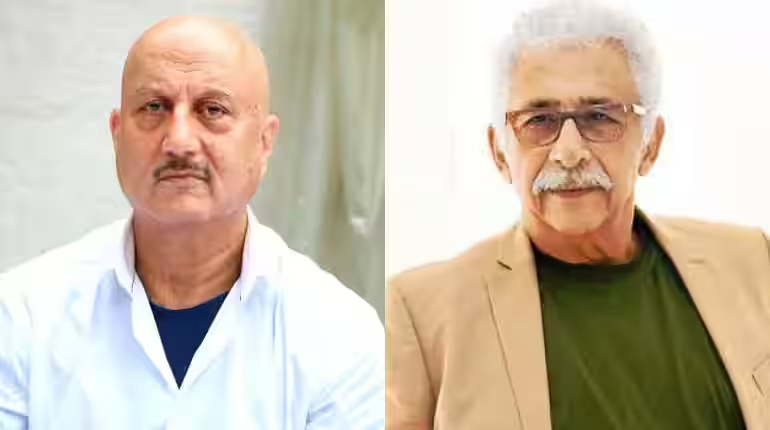
There is no press release for the moment a real feud ends. No joint statement, no coordinated photo op, no carefully worded olive branch drafted by a publicist. If Anupam Kher's telling is accurate, the six-year rift with Naseeruddin Shah ended the way most real reconciliations do: unplanned, at a funeral, in two words.
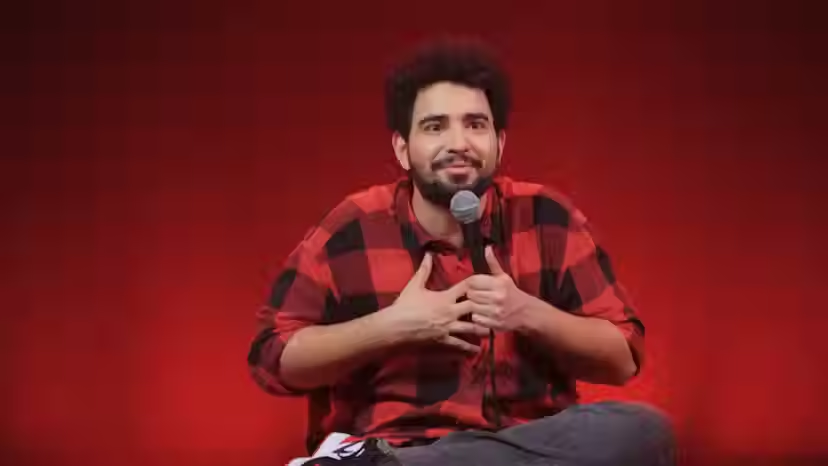
The setting was the memorial service for H.D. Pathak, a chartered accountant who had worked with both actors over the years, the kind of shared professional connection that puts two people in a room together whether or not either of them planned for it. According to Kher, recounting it later on Samdish's YouTube show Unfiltered by Samdish, he and Shah spontaneously hugged. Shah said, simply, Sorry, yaar.
It's worth sitting with how small that moment actually was, structurally, against how large the original wound had been. In January 2020, Shah had called Kher a clown and a sycophant in an interview with The Wire, adding that the sycophancy was in his blood and something he couldn't help. That's not a passing insult. That's a character verdict, delivered on the record, in the middle of one of the most heated political moments in recent Indian public life, then clipped, replayed and turned into a permanent internet artifact that followed Kher around for half a decade. Against that, an apology delivered in two words at a memorial service sounds almost too modest to close the book. And yet, by Kher's account, it did.
What makes the moment land isn't the scale of the apology. It's the setting. A memorial service isn't a stage. There's no incentive to perform reconciliation for cameras, no PR calculus about which outlet gets the exclusive. It's just two men who've known each other since their National School of Drama days, standing in a room built for grief, running into each other, and finding that whatever they were still holding onto didn't feel worth carrying into that particular room. That's a genuinely different kind of apology than the kind engineered for an interview cycle.
Kher's account afterward is where the story gets more interesting than a simple happy ending. He didn't describe the apology as erasing the disagreement. He said he still holds deep admiration for Shah, calls him brilliant, considers him unmatched in parallel cinema and one of the actors who shaped his own career, while also noting, plainly, that Shah sometimes speaks loosely about him or other big names. That's not the language of someone pretending nothing happened. It's the language of someone who got the apology he wanted for how something was said, without needing the other person to fully recant what he meant.
In a separate conversation, Kher framed the whole arc as a decision to let it go, saying he no longer has the time or desire to stay stuck in animosity. That's a specific kind of maturity that public feuds rarely get credit for, the choice to stop relitigating an old wound not because you've decided you were wrong to be hurt, but because you've decided the hurt has done its job and doesn't need to keep working.
It's worth noting what's missing from this story too: a detailed account from Shah's own side. Most of what's public comes from Kher's retelling, which means the full emotional weight of that hug, from Shah's perspective, remains mostly private. Shah has continued, since, to be cited as a blunt, sometimes controversial commentator on politics and the industry, someone who hasn't softened his broader willingness to say what he thinks about colleagues. The apology closed one specific chapter. It didn't rewrite the man.
Which might be the most honest ending this particular story could have gotten. Not a full ideological truce, not a joint interview walking back every word, just two words, in a hug, at a funeral, five years after a soundbite that outlived the moment it came from. Sometimes that's what closure actually looks like: quieter than the fight, and a lot less shareable.


Comments