



Krishna Janmashtami : Puranic Itihaas And Cinema History

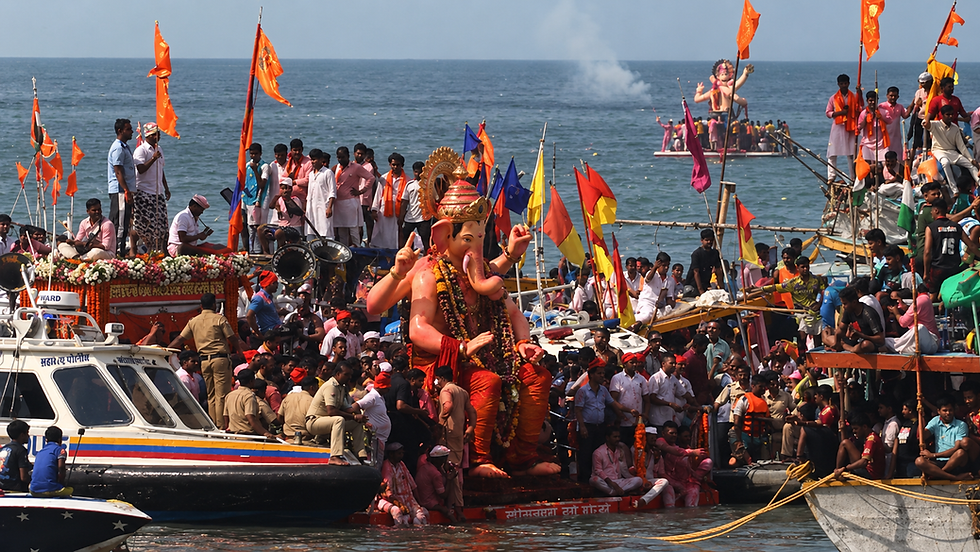
On the dark night of Bhadrapada Krishna Ashtami, temple bells echo across India as priests gently rock decorated swings holding idols of baby Krishna. The serenity of the midnight birth is abruptly followed by the explosive energy of the next morning. Streets transform into vibrant, chaotic arenas where thousands of energetic Govindas form towering human pyramids, reaching for earthen pots suspended dizzyingly high above the pavement.
Krishna Janmashtami and the accompanying Dahi Handi festival represent the most physically thrilling celebration in the Hindu calendar. For modern seekers and cultural historians, this festival serves as a radical departure from solemn, ascetic forms of worship. Janmashtami approaches the divine through pure joy, physical teamwork, and rhythmic celebration. When Indian filmmakers recognized the cinematic potential of this festival, they began drawing directly from Krishna's Puranic life to craft some of the most visually stunning, high-octane sequences in cinematic history.
To truly understand why Bollywood relies so heavily on this festival for dramatic storytelling, we must first trace the origins of these traditions back to the ancient scriptures and observe how differently they are celebrated across the Indian subcontinent.
From Mathura's Dungeon To Gokul's Pastures
The scriptural foundation of Janmashtami is meticulously documented in the Bhagavata Purana and the Harivamsa. The narrative arc moves from extreme political oppression to ultimate divine liberation.
The Midnight Birth In A Mathura Prison
King Kansa, the tyrannical ruler of Mathura, was warned by an ethereal divine voice that the eighth child of his sister Devaki would be his eventual executioner. Paralyzed by fear and paranoia, Kansa imprisoned Devaki and her husband Vasudeva in a heavily guarded subterranean dungeon, ruthlessly executing their first seven newborn infants.
On the eighth day of the dark fortnight of Bhadrapada, under the auspicious Rohini Nakshatra, Lord Krishna took birth at exactly midnight inside the bleak prison cell. The moment the divine child appeared, the physical world bent to his will. The heavy iron chains binding Vasudeva and Devaki shattered instantly, the massive prison gates swung open, and the royal guards collapsed into a deep, hypnotic slumber.
Knowing the child's life was in danger, Vasudeva placed baby Krishna inside a woven wicker basket and ventured out into a violent, torrential storm. When he reached the roaring, swollen banks of the Yamuna river, the cosmic serpent Sheshnaag emerged from the depths. Spreading his massive hoods like an umbrella, Sheshnaag shielded the baby from the driving rain. The Yamuna miraculously parted its waters, allowing Vasudeva to cross safely to the pastoral village of Gokul. There, he swapped Krishna with Yashoda's newborn daughter, securing the divine infant's survival.
Defeating Kansa's Demonic Assassins
Kansa soon realized he had been deceived and deployed a terrifying roster of demonic assassins to Gokul, ordering them to slaughter all newborn infants.
The first to arrive was the demoness Putana. She disguised herself as a beautiful, maternal figure, secretly coating her breasts with lethal poison. When she offered her breast to baby Krishna, the divine infant closed his eyes and mercilessly sucked out not only the poison but her very life force, liberating her dark soul in the process.
Next came Shakatasura, a powerful entity who possessed a massive wooden handcart, intending to crush the sleeping toddler. Krishna simply kicked the heavy cart with his tiny foot, obliterating the wooden structure into thousands of splinters.
Kansa then dispatched Trinavarta, a terrifying whirlwind demon. Trinavarta swept young Krishna high into the stratosphere, trapping him inside a blinding, suffocating dust storm. In response, Krishna made his physical body infinitely heavy, gripping the demon's neck with inescapable force until Trinavarta plummeted to the earth, shattered upon impact. These early miracles firmly established that Krishna, despite appearing as a helpless infant, commanded absolute cosmic authority.
Gokul's Makhan Chori And The Birth Of Dahi Handi
Growing up in Gokul under the loving care of Nanda Baba and Yashoda, young Krishna displayed notorious mischief. His absolute favorite treats were fresh butter (Makhan) and curd (Dahi). Desperate to protect their freshly churned dairy, the village women tied their earthen clay pots securely to the highest wooden roof rafters of their homes.
Krishna gathered his young cowherd friends and devised a brilliant tactical solution. The boys stood firmly on each other's shoulders, forming the world's very first human pyramids. Krishna scaled the backs of his friends to reach the very top, used a wooden stick to shatter the clay pot, and joyfully distributed the dripping butter to his friends and the local monkeys.
This iconic childhood act functioned as a symbolic rebellion against Kansa's oppressive taxation system, which unfairly demanded that Gokul's rich milk and butter be exported to the Mathura palace. Today, this legend forms the absolute foundation of the modern Dahi Handi festival. Furthermore, when the rain god Indra unleashed apocalyptic storms upon Gokul, Krishna famously lifted the massive Govardhan Hill on his little finger for seven consecutive days, proving that the supreme divine lives among humble pastoral workers and fiercely protects them.
Regional Janmashtami Celebrations Across India
While the core narrative of Krishna's birth remains constant, the physical celebration of Janmashtami morphs dramatically depending on which Indian state you visit. The festival serves as a massive cultural canvas, painted differently by local regional customs.
In Uttar Pradesh, specifically in Mathura and Vrindavan where Krishna was born and raised, the celebrations stretch for weeks. The temples are heavily decorated, and professional theater troupes perform the Raas Leela, enacting romantic and heroic episodes from Krishna's life. Millions of pilgrims gather at the Krishna Janmasthan Temple, waiting for the midnight hour when the deity's idol is bathed in milk and honey (Abhishekam) amidst deafening chants.
In Maharashtra, the festival is entirely synonymous with the aggressive, adrenaline-fueled Dahi Handi competitions. Political parties and local businesses sponsor massive events, hanging pots of curd, honey, and money sometimes fifty feet in the air. Neighborhood Govinda pathaks practice for months to build flawless, multi-tier human pyramids in the pouring rain, competing for massive cash prizes and neighborhood glory.
In Gujarat, particularly in the holy city of Dwarka where Krishna ruled as king, the festival takes on a deeply devotional yet incredibly joyous tone. Women perform traditional Garba and Dandiya Raas dances throughout the night. Local variations of the Makhan Handi are also organized, but the focus leans heavily toward communal dancing and devotional singing rather than pure athletic competition.
In South India, the customs diverge into highly specialized local rituals. In Udupi, Karnataka, the festival is celebrated as Sri Krishna Janmashtami and Vitla Pindi. The unique highlight here is the Huli Vesha, where skilled dancers paint their bodies with intricate tiger stripes and perform aggressive, acrobatic routines on the streets. In Tamil Nadu and Andhra Pradesh, devotees draw tiny footprints using rice batter from the threshold of their homes leading into the kitchen, symbolically inviting baby Krishna to walk inside and steal their butter.
Silver Screen Pyramids: Cinema Captures The Govinda Spirit
Indian filmmakers recognized decades ago that Janmashtami offered two distinct, highly cinematic visual palettes: the high-octane urban spectacle of Mumbai's street pyramids or the graceful folk traditions of village Rasleela dances. Over the years, Bollywood has built an entire sub-genre of unforgettable Dahi Handi anthems, utilizing the festival to establish a hero's raw physical power or community connection.
OMG Oh My God (2012): The Modern Motorcycle Entry
In Umesh Shukla's brilliant satirical drama, the Dahi Handi festival is weaponized for one of the most innovative character introductions in modern Indian cinema. A young Govinda loses his footing and plunges downward from a collapsing pyramid. Suddenly, Lord Krishna himself (Akshay Kumar) tears into the alleyway on a sleek sports motorcycle. Wearing a black leather jacket, he casually catches the falling boy mid-air, leaps from his moving bike, and steps onto the crumbling pyramid to break the pot himself, masterfully modernizing Krishna's divine intervention for urban street culture.
Agneepath (2012): The Intense Urban Smash
In Karan Malhotra's gritty revenge drama, the Dahi Handi sequence functions as a hyper-masculine reintroduction to Hrithik Roshan's character. Completely soaked in colored water, Hrithik scales a massive four-tier human wall with predatory speed to the aggressive dhol beats of "Ala Re Ala Govinda". Standing unsupported at the top, he locks eyes with his mortal enemy (Rishi Kapoor) and smashes the earthen pot with devastating force, perfectly capturing the inherent danger and intense neighborhood tribalism of Mumbai's real-life competitions.
Vaastav: The Reality (1999): The Authentic Chawl Celebration
Mahesh Manjrekar's underworld drama perfectly captured the unfiltered spirit of Dahi Handi as celebrated in working-class chawls. The iconic song "Har Taraf Hai Yeh Shor" features Sanjay Dutt dancing with unpolished, raw masculine energy alongside his friends. Shot with a gritty, documentary-style aesthetic, the sequence beautifully illustrates how Dahi Handi serves as a massive unifying force, bringing rival factions together in shared physical effort before the hero's eventual descent into the criminal underworld.
Lagaan (2001): The Elegant Village Rasleela
Providing a serene contrast to the urban street fights, Ashutosh Gowariker's Lagaan utilizes the Janmashtami celebration in Champaner for the classic song "Radha Kaise Na Jale". Aamir Khan playfully mimics an imaginary flute, while Gracy Singh retaliates with sharp classical dance steps, perfectly enacting Radha's legendary jealousy. Illuminated by flickering oil lamps, the entire village joins in a synchronized circular folk dance, capturing the pure, devotional romance of the festival.
Hello Brother (1999) & Khud-Daar (1982): The Festive Anthems
Bollywood relies heavily on Dahi Handi for massive, colorful dance numbers. In Hello Brother, Salman Khan leads an incredibly colorful celebration, climbing a massive five-tier pyramid to smash the pot amidst clouds of pink gulal powder to the thumping track "Chandi Ki Daal Par Sone Ka Mor". Decades earlier, Amitabh Bachchan completely dominated the Janmashtami cinematic space in Khud-Daar. Leading a massive procession to the song "Mach Gaya Shor Sari Nagri Re", Amitabh's towering physical swagger firmly established Dahi Handi as a crucial cinematic set-piece for connecting the hero to the common man.
Bluffmaster (1963): The Original Street Govinda Classic
In Manmohan Desai's 1963 classic, legendary actor Shammi Kapoor effectively wrote the cinematic blueprint for all future Dahi Handi songs with the immortal track "Govinda Aala Re Aala". Shot on real Mumbai streets with actual chaotic neighborhood crowds, Shammi Kapoor spins through the soaked street, climbs a three-tier pyramid, and gleefully smears fresh curd across his face. His raw, unpolished, joyful energy set a gold standard that modern filmmakers continue to emulate six decades later.
For massive international audiences and NRI communities eager to stream these festive blockbusters, classics like Lagaan are available globally on Netflix, while OMG Oh My God, Agneepath, and Vaastav stream actively on Amazon Prime Video and ZEE5.
The Final Word
Krishna Janmashtami and the incredible tradition of Dahi Handi stand as vibrant, undeniable proof of Indian culture's unique ability to transform ancient scripture into living, breathing public joy.
Whether expressed through Aamir Khan's rural village dance in Lagaan, Amitabh Bachchan's towering swagger in Khud-Daar, Sanjay Dutt's gritty chawl celebration in Vaastav, or Akshay Kumar's shockingly modern motorcycle entry in OMG, Indian cinema has successfully captured the absolute soul of Lord Krishna's message.
As long as heavy dhol beats continue to echo through Mumbai's crowded streets, the fearless spirit of Govinda will inspire millions across the globe.
FAQ Section
What is the exact Puranic story behind Lord Krishna's birth on Janmashtami?
According to the ancient Bhagavata Purana, Lord Krishna was born precisely at midnight in a dark Mathura prison cell to Devaki and Vasudeva. The prison doors miraculously unlocked, allowing Vasudeva to carry baby Krishna across the stormy Yamuna river under Sheshnaag's protection to safety in Gokul.
How is Janmashtami celebrated differently in South India compared to Maharashtra?
While Maharashtra celebrates with aggressive Dahi Handi human pyramids on the streets, South India honors the day differently. In Udupi, Karnataka, devotees perform the athletic Huli Vesha (Tiger Dance), and in Tamil Nadu, households draw tiny rice-batter footprints leading into their kitchens to welcome baby Krishna.
How does OMG Oh My God depict the Dahi Handi festival?
In the 2012 film OMG Oh My God, Akshay Kumar makes a stunning entry as Lord Krishna riding a modern sports motorcycle. He casually rescues a falling Govinda mid-air during a human pyramid collapse before effortlessly climbing up to break the clay pot himself.
Why do people form massive human pyramids for Dahi Handi?
Dahi Handi directly re-enacts young Krishna's childhood antics in the village of Gokul, where he formed unstable human pyramids with his shepherd friends to reach and steal clay pots of fresh butter suspended high from wooden house rafters.
Which movie featured Hrithik Roshan breaking a Dahi Handi to the song Ala Re Ala Govinda?
Hrithik Roshan performed a highly intense, muscular Dahi Handi scene set to the heavy dhol beats of "Ala Re Ala Govinda" in the 2012 revenge drama Agneepath, directed by Karan Malhotra.

Comments