
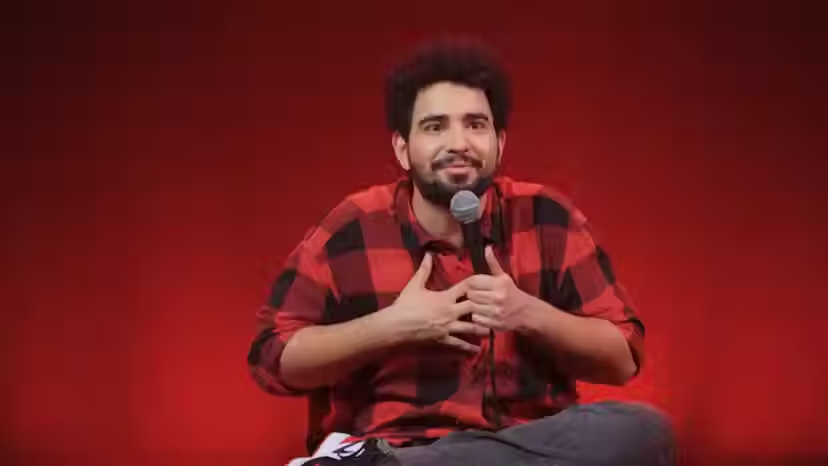


From Phone Camera to Freedom Fighter: Bhuvan Bam’s Ten-Year Climb Into the Acting Establishment

Bhuvan Bam’s arrival as Rash Behari Bose in Prime Video’s The Revolutionaries looks spectacular when viewed from 2026. Look backwards, however, and the supposed overnight success dissolves into ten years, billions of views, hundreds of uploads, failed auditions, songs, characters, experiments, production risks and an audience patiently carried from one medium into another.
There is a rather extraordinary photograph hiding in plain sight in the story of Bhuvan Bam.
On one side of the decade is a young man holding up a phone, shooting himself, changing his voice, pulling faces, impersonating relatives and inventing a repertory company from the dimensions of a bedroom.
On the other is the same man, period costume fitted, spectacles on, carrying the role of Rash Behari Bose in Nikkhil Advani’s large-scale historical drama The Revolutionaries, released worldwide on Prime Video on September 11, 2026. Bam now shares the marquee with Rohit Saraf, Pratibha Ranta and Gurfateh Pirzada in an eight-episode series inspired by Sanjeev Sanyal’s Revolutionaries: The Other Story of How India Won Its Freedom.
That juxtaposition deserves to be contemplated properly.
Because somewhere between those two images sits an entire transformation in how Indian celebrity is manufactured.
And somewhere inside that transformation sits roughly 5.37 billion YouTube views.
As of September 2026, BB Ki Vines has approximately 26.5 million subscribers, 5.37 billion cumulative views and 195 public videos, according to Social Blade. Bam’s Instagram account, meanwhile, sits at roughly 20.7 million followers.

Think about those numbers before calling anybody an overnight success.
First, he was never really a TikTok star
The tendency now is to place every internet-born celebrity into the same linguistic bucket: influencer, TikToker, creator, Instagrammer.
Bam’s chronology is more interesting than that shorthand.
His rise predates TikTok’s great Indian cultural moment. He was a college student and musician, performing for hours at a restaurant in Delhi, when he began making videos. Bam has repeatedly recalled that an early satirical clip was inspired by television coverage of the Kashmir floods, after he saw a reporter ask a grieving woman an extraordinarily insensitive question. The video travelled, particularly among viewers outside India. A later Valentine’s Day video helped him find an Indian audience. BB Ki Vines formally arrived on YouTube in 2015.
Hindustan Times described him in 2019 as a college student who had been singing at a Mughlai restaurant in Delhi before becoming one of the first great stars of Indian YouTube. Four years into BB Ki Vines, the channel already had around 13.3 million subscribers and 1.69 billion views.
By 2021, that subscriber figure had climbed beyond 24 million.
There is a useful lesson in the progression.
The internet has corrupted our perception of time because virality looks instantaneous from the outside. We see the moment something erupts. We seldom count everything uploaded before and after the eruption.
Bam himself once said he could not remember precisely how many videos it took him to hit 100,000 or one million YouTube subscribers. He had already accumulated an audience on Facebook and moved some of those videos across to YouTube.
So there is no intellectually honest way of producing a neat little equation saying Video No. 37 created Bhuvan Bam.
There is, however, another number.
Five billion views.
That is five billion tiny acts of audience validation accumulated over a decade.
Acting schools speak of hours spent performing before an audience. Bam had a rather unusual acting school. His classroom was the front-facing camera. His scene partners were also Bhuvan Bam. His audience eventually became the population of a small continent.
The bedroom became a repertory theatre
BB Ki Vines was frequently treated as disposable internet comedy because that was how traditional entertainment regarded YouTube in the middle of the last decade.
In retrospect, something more consequential was happening.
Bam was learning character construction.
Titu Mama, Bancho, Sameer Fuddi, Bablu, Janki and the others became an indigenous digital repertory company, performed largely by one man.
The production values were rudimentary. The acting exercise was not.
To move between recognisable characters using changes of posture, cadence, expression, vocabulary and costume is training of a sort. It does not automatically create Laurence Olivier, obviously. But repetition creates craft. More importantly, it creates an instinctive understanding of an audience.
That distinction mattered when Bam began asking viewers to follow him into longer stories.
His 2018 short film Plus Minus, opposite Divya Dutta and produced with Guneet Monga’s Sikhya Entertainment, moved him beyond the self-contained BB Ki Vines universe. It ultimately won the Filmfare Short Film Award’s People’s Choice honour. The film itself has accumulated more than 33 million views on YouTube.
Then came Dhindora in 2021.
This was the bridge.

An eight-episode comedy-drama built around the characters Bam had spent years developing, Dhindora allowed him to turn internet sketches into serialised narrative entertainment. Bam created the story, co-wrote the screenplay, produced the series and performed multiple roles. By July 2022, the show had crossed 500 million views on YouTube.
Half a billion views.
At some point we have to stop referring to such numbers as merely “creator reach”. That is distribution.
Then came Vasya
The most important transformation arrived with Taaza Khabar in 2023.
Here Bam could no longer retreat completely behind Titu Mama’s moustache or a familiar comic voice.
Playing Vasant “Vasya” Gawde required him to anchor a conventional dramatic narrative alongside established performers including Shriya Pilgaonkar, Shilpa Shukla, J.D. Chakravarthy and Deven Bhojani.
It was also his OTT acting debut.
And it worked commercially.
Ormax Media estimated Taaza Khabar at 23.5 million viewers in 2023, making it the third most-watched Hindi streaming series of that year behind Farzi and The Night Manager.
Pause again.
A man who had been filming himself on a phone was suddenly appearing on the same annual audience leaderboard as Shahid Kapoor, Vijay Sethupathi, Aditya Roy Kapur and Anil Kapoor.
That is where “influencer becomes actor” stops being sufficient as a description.
Bam had begun migrating an audience.
A second season of Taaza Khabar followed in September 2024, with Jaaved Jaaferi joining the ensemble. Whatever one thought of the series itself, the more important industrial development was obvious: Bam had acquired enough legitimacy for a streaming platform to treat a Bhuvan Bam dramatic property as renewable IP.
In the same general period there was Rafta Rafta, the seven-episode 2023 romantic comedy produced through BB Ki Vines and released on Amazon miniTV, where Bam played one half of an awkward newlywed couple.
Prime Video then handed him another form of cultural inheritance when he supplied Hindi commentary for the reboot of Takeshi’s Castle, resurrecting Titu Mama for the job once occupied in Indian millennial memory by Jaaved Jaaferi.
Each step expanded the radius.
Sketch comedian. Musician. Short-film actor. Writer. Producer. Web-series lead. Romantic lead. Voice performer. Dramatic streaming star.
And now Rash Behari Bose.
The Revolutionaries changes the category again
The Revolutionaries matters because Bam has finally entered a production where the Bhuvan Bam brand is no longer the entire architecture around him.
He is playing an actual historical figure.
Rash Behari Bose belongs to a political, revolutionary and historical memory that existed long before BB Ki Vines, YouTube or Bhuvan Bam himself. The role requires Bam to submit his existing persona to somebody else’s world.
The reviews published on release day are already divided, which is healthy. Outlook found dramatic ability in his performance while wishing the writing offered Bose greater interiority. Moneycontrol and Cinema Express were considerably less persuaded by his gravitas in the role.
That debate is almost beside the point for the purposes of this essay.
He has reached the stage where his acting can be reviewed independently from his internet celebrity.
That is progress.
A critic saying Bhuvan Bam gave a weak performance as Rash Behari Bose is, paradoxically, evidence that the transition has happened. The critic has begun treating him as an actor and applying the standards of acting.
The protective asterisk labelled “YouTuber” is slowly disappearing.
Now, about privilege
Success mythology becomes tedious when every successful individual is rewritten as somebody who emerged from absolute nothingness.
Almost nobody does.
Talent matters. Work matters. Luck matters. Timing matters. Geography matters. Family matters. Language matters. class matters. Technology matters. Networks matter. Historical circumstance matters.
Privilege does not invalidate work. It changes the starting conditions under which work is performed.
And I say this as a person who has enjoyed privilege myself. I know perfectly well that having certain advantages does not wake up in the morning and perform the labour for you. Privilege may put the gymnasium closer to your house. You still have to lift the weight.
There are, however, some lazy assumptions about Bam that should be discarded.
Calling him simply a “North Indian” by ethnicity obscures a more complicated biography. He was born in Vadodara, grew up in Delhi and has publicly referred to his Maharashtrian background.
What clearly mattered professionally was his location within urban, Hindi-speaking Delhi culture.
He attended school in Delhi and studied history at Shaheed Bhagat Singh College, Delhi University. He emerged during precisely the period when inexpensive smartphones, Facebook and YouTube were democratising entertainment distribution among urban Indian youth.
That is a form of infrastructural privilege.
Access to a smartphone is privilege relative to someone without one.
Access to reliable internet is privilege.
Living in a major cultural metropolis is privilege.
Being linguistically fluent in the Hindi vernacular that could travel across northern, central and western India gave BB Ki Vines an enormous addressable cultural market.
Being educated enough to navigate the early creator economy helped.
And being male in the first generation of Indian internet comedy came with freedoms of movement, speech, vulgarity and experimentation that women creators frequently had to negotiate rather differently.
These things belong in the analysis because pretending everybody begins a race with their toes touching precisely the same white line is sentimental nonsense.
Caste requires more care
Caste is obviously part of the Indian distribution of opportunity. Any serious conversation about privilege in India can examine caste structurally.
What I will not do, however, is assign Bhuvan Bam a caste by reverse-engineering his surname.
I have found no reliable self-identification from Bam that would justify confidently placing him into a caste category, and journalism becomes astrology when we begin deciding somebody’s caste because a surname “sounds” Brahmin, Kshatriya, upper caste or otherwise.
The larger point survives perfectly well without that speculation.
Bam possessed certain identifiable forms of cultural and infrastructural capital.
He then leveraged them spectacularly.
That second sentence matters.
Because millions of people possess advantages they never convert into anything remotely resembling five billion views.
Privilege is a head start, not a completed marathon
Indian discourse has developed a strange relationship with privilege.
We either deny it entirely or behave as though identifying it somehow confiscates achievement.
Both positions are intellectually impoverished.
An individual can benefit from favourable starting conditions and work extraordinarily hard.
I can testify to that from my own life.
The interesting question is what somebody does with whatever inheritance of circumstance they receive.
Bam did something unusually productive with his.
The phone became a studio.
The bedroom became a set.
The audience became distribution.
Distribution became negotiating power.
Negotiating power became a production company.
The production company became IP.
The IP created acting opportunities.
The acting opportunities created legitimacy.
And legitimacy has now placed him inside a Prime Video historical epic playing one of the revolutionaries of the Indian independence movement.
That is leverage.
He belongs to a larger creator class
Bam is not alone, either.
India is now watching the first mature generation of native digital celebrities push beyond the platforms that created them.
Ashish Chanchlani, one of Bam’s closest generational contemporaries, has moved from comedy sketches into large-scale long-form storytelling with Ekaki. Released independently on YouTube, the science-fiction comedy had accumulated nearly 150 million views across five episodes by March 2026, while allowing Chanchlani to operate as writer, director, producer and performer.
Prajakta Koli has crossed much more conventionally into acting, carrying Netflix’s Mismatched through multiple seasons and into a fourth and final season now in production.
Kusha Kapila, Dolly Singh and others have similarly tested the membrane separating influencer culture from film and streaming entertainment.
Then there is Orry, Orhan Awatramani, who represents another creature altogether.
Orry demonstrates that contemporary celebrity can itself become the product. He has migrated from social adjacency and Instagram notoriety into reality television and the broader entertainment economy, most recently appearing in Khatron Ke Khiladi 15.
Different talent models, different starting conditions, same underlying phenomenon.
The monopoly over manufacturing celebrity has fractured.
Film studios no longer possess the only furnace.
The audience came before the establishment
This is perhaps the most important thing about Bhuvan Bam.
Old Bollywood worked through institutional permission.
Somebody had to notice you.
Somebody had to audition you.
Somebody had to introduce you.
Somebody had to finance you.
Somebody had to distribute you.
Somebody had to decide that the public might want you.
Bam reversed the sequence.
The public decided first.
The institutions arrived later.
And there is something wonderfully disruptive about that.
By the time traditional entertainment could decide whether Bhuvan Bam had “star quality”, tens of millions of people had already answered the question.
Hollywood has long understood that celebrity can migrate between television, music, comedy, radio, sport and cinema. India’s legacy entertainment industry maintained much harder borders.
The creator economy smashed several of them.
Five billion auditions
Perhaps that is the best way to understand Bam’s career.
BB Ki Vines was one enormous, decade-long audition.
Except the casting director was the Indian public.
Every upload produced data.
Every character supplied feedback.
Every failed joke disappeared.
Every successful one became memetic.
Every million views sharpened his understanding of timing.
Every comment section operated as the world’s largest unsolicited focus group.
Every platform migration taught him something about audience retention.
Then Dhindora proved he could stretch attention.
Plus Minus suggested he could share the screen.
Taaza Khabar demonstrated that an OTT audience would accept him as a dramatic protagonist.
Its second season proved the first was no accident.
Rafta Rafta widened the register.
Takeshi’s Castle exploited the voice.
And The Revolutionaries now asks the most difficult question yet: can Bhuvan Bam disappear sufficiently into another human being?
We will argue about the answer.
We should.
That is what actors are for.
Bhuvan Bam has earned the argument
I find myself less interested in whether Bhuvan Bam has finally “made it” than in what his career tells us about where Indian entertainment is going.
The old hierarchy placed cinema at the top and everything else beneath it.
The new hierarchy is liquid.
A teenager might command greater cultural power from a YouTube channel than a supporting actor appearing in twenty Hindi films. A creator can own his audience, production company and intellectual property before a studio ever knocks on the door.
Bam understood that world earlier than most.
Some privilege helped give him the opportunity to participate in it.
Some luck accelerated him.
Technology lowered the gate.
But none of those things wrote 195 videos, accumulated 5.37 billion views, carried Dhindora past half a billion views, turned Taaza Khabar into one of 2023’s most-watched Hindi streaming shows, or transformed a Delhi restaurant singer into the man Prime Video would eventually cast as Rash Behari Bose.
That took work.
Lots of it.
Which is why the most remarkable thing about Bhuvan Bam’s so-called exponential rise is that, viewed from close enough, the exponential curve is made of thousands upon thousands of very small increments.
A joke.
A video.
A million views.
Another character.
Another rejection.
Another upload.
Another experiment.
Another platform.
Another role.
Until one day the boy holding the phone is standing on a period set, dressed as a revolutionary.
From ten-minute vines to Rash Behari Bose.
Somewhere inside those five billion views, Bhuvan Bam became an actor.
And perhaps we were simply too busy scrolling to notice.


Comments